Also See: Endorsements and Purchase Information 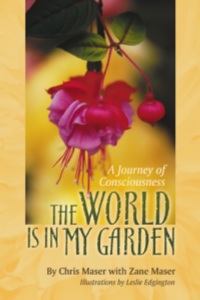
TABLE OF CONTENTS
-
PREFACE
CHAPTER 1, MY GARDEN AS METAPHOR
-
CHAPTER 2, THE GATE OF ECOLOGICAL CONSCIOUSNESS
Gardening Changed the World
-
The First Garden
Gardening Is A Reciprocal Relationship
Gardening Makes Ecosystems Increasingly Fragile
Exercise in Conscious Awareness
-
The Foundation of Gardening-Soil, Air, and Water
-
The Wonder Of Soil
An Ocean Of Air
Water Seeks The Lowest Level
Exercise in Conscious Awareness
-
I Participate with the Whole World while Working in My Garden
-
Exercise in Conscious Awareness
-
We must Reinvest in Nature even as We do in Business
-
Exercise in Conscious Awareness
-
CHAPTER 3, THE GATE OF SOCIAL CONSCIOUSNESS
Community begins in a Garden
-
The Concept of Community
Community Must be Human in Scale
Exercise in Conscious Awareness
-
Boundaries are the Language of Sacred Spaces
-
Exercise in Conscious Awareness
-
Rights, Although of Noble Intent, have become the Fodder of Injustice
-
Exercise in Conscious Awareness
-
The Misunderstood Privilege of Trusteeship
-
Exercise in Conscious Awareness
-
The Way We Participate with Nature
-
When "Helping" Is Interfering
Conscious Participation
Exercise in Conscious Awareness
-
On the Meaning of "Natural" and "Native"
-
Exercise in Conscious Awareness
-
Prejudice is Ignorant Judgment
-
Exercise in Conscious Awareness
-
The Environment is Our Social Mirror
-
Exercise in Conscious Awareness
-
CHAPTER 4, THE GATE OF PERSONAL CONSCIOUSNESS
Self-Knowledge is a Lifetime of Discovery
-
Exercise in Conscious Awareness
-
I Relate to Life through Experiences and thus Know I Exist
-
Exercise in Conscious Awareness
-
Crisis is the Face of a Focused Opportunity
-
Exercise in Conscious Awareness
-
Change is a Universal Constant
-
Exercise in Conscious Awareness
-
I Always have a Choice, and I Must Choose
-
Exercise in Conscious Awareness
-
To be in Control, I must give up trying to Control
-
Exercise in Conscious Awareness
-
Killing is an Act of Living that I cannot Avoid
-
Exercise in Conscious Awareness
-
Death is a Horizon beyond which I cannot See
-
Exercise in Conscious Awareness
-
Grief is the other Side of Joy
-
Exercise in Conscious Awareness
-
Patience seems an Eternal Lesson
-
Exercise in Conscious Awareness
-
CHAPTER 5, THE GATE OF SPIRITUAL CONSCIOUSNESS
-
Faith is Belief without Evidence
-
Exercise in Conscious Awareness
-
Stabilitas in Gardening Facilitates inner Transformation
-
Exercise in Conscious Awareness
-
Making Sacred that which is Material
-
Exercise in Conscious Awareness
-
Balancing Activity with Inactivity
-
Exercise in Conscious Awareness
-
Making Enough, Enough
-
 Exercise in Conscious Awareness
-
Acceptance is the Key to Freedom
-
Exercise in Conscious Awareness
-
In Emptiness is Spiritual Fulfillment
-
Exercise in Conscious Awareness
-
Finding Peace in My Garden
-
Exercise in Conscious Awareness
-
AFTERWORD
ENDNOTES
APPENDIX (Return to Top of Page)
Endorsements:
"I confess to being an enthusiast for this book. 'The World is in My Garden' is based on a very simple formula, but one as far as I know never carried through in book form (there are plenty of poems in history that qualify): the idea that the private garden is a metaphor for everything that goes on in the macrocosm, including ecological, social, personal, and spiritual issues. ... I have rarely so genuinely wished such a venture success.
"The notion of a garden has always been a metaphor for consciousness. There is the garden of Gethsemane; the gardens in which Persian and Eastern mystics saw their visions; the garden of Eden. In western literature and art there is a long-running metaphor of the garden: the hortus conclusus, the enclosed space as representing communion with the virgin, the mother, and with the feminine.
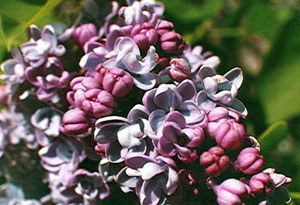
Lilac in spring glory.
"In this garden, the eternal woman is shown encountering the unicorn; the virgin receives the angel Gabriel who announces to her the nativity—while a white lily in the painting attests her purity. Much later in art, the garden may be an image of wild nature; although none of these images are specifically taken up by the Masers, their garden certainly attests to the wild as well as to the enclosed and sacred. I simply wish to put the metaphor in its context: let them tell us what it means for today's world.
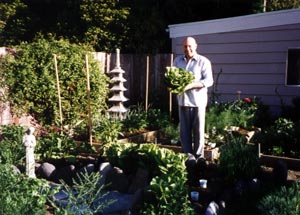
"This is a very intelligent sort of book. What simplifies it is human experience, the fact that it is their garden, Chris and Zane's: not just a metaphor but a very real place (indeed, if there is anything I miss at all in this book it is simply a description of the garden itself so that, as I consider the ideas raised, I can feel at home—and explore with my eyes as well as my ears). Chris writes, 'It is through gardening that I have struggled with such concepts as crisis, self-knowledge, experience, change, killing, death, and peace.' That he has wrestled with them actually in the garden of their Oregon home, is continually evident, both in the anecdotes of the book and in the general reference to the plants, weeds, insect and mammal life, predators, diseases, the compost, the young shoots, the cycle of generation and decay, and the presence in this remarkable space of two human beings—beings who are fundamentally part of the system, not even remotely separate.
"And that is a key concept of Chris's ecology. He is not, I may say, someone full of ecological clichés: he is an original thinker around ecological issues, at times even a rebel within his own field (which is principally, but not entirely, forestry). At one stage I thought that it was only the comparison between the garden microcosm and the ecological macrocosm that the book was about. I could not have been more wrong: it has five sections, one of which is introductory. The others see the garden as metaphor for social issues (here questions of community, trusteeship, what is natural, how we can help, all get discussed); for personal issues (I particularly liked the discussion of the concept of crisis and opportunity, but this also includes a look at grief and death), and spiritual ones (transformation, acceptance, finding peace).
"If I say that MY GARDEN is a work of criticism I run the risk of puzzling readers of this magazine. But in the best sense of that word, it is precisely what this book is, and that is no mean compliment. The book is a criticism, that is to say a constructive exploration, of what really is our role in community, one with another and in participation with nature, and it will most certainly enlarge the mind. And that, too, I mean in the best sense."
Colum Hayward
Bookshelf
Stella Polaris
(a British magazine)
London, UK
"Here is a book that says: 'Come ye apart a while' into the inner garden and take a closer look at some of our Western values. You will come back from this journey of consciousness with some changed view points. I feel The World is in My Garden should be required reading for all college students for the next generation because we must learn to tread lightly on the Earth."
Edna Cowan
Perkasie, PA
"This is the perfect time of year [December] to sit at the kitchen window on a rainy day, gazing at what winter is doing to the garden and contemplating the meaning of life.
"The garden, after all—or in my case, the weed patch—is the ultimate extension of our personal self, far beyond how we decorate our homes. The house looks nice to our guests, but we commit ourselves to the world with statements we make in the garden.
'While I may in a legal sense 'own' the land in which my garden resides, I can only borrow it in a moral sense. I am therefore both a temporary custodian and a trustee of my garden for those who must someday live where I now dwell,' Chris Maser of Corvallis writes in his new book, The World is in My Garden: A Journey of Consciousness.
"Maser, 63, a consulting research zoologist and ecologist, is best known (to me, anyway) for his excellent reference work, Mammals of the Pacific Northwest, a comprehensive and scientifically pinpoint-accurate guide to the warm-blooded critters with which we share space.
"But unlike many other scientists, who spend their energy on their science and keep their own counsel, in this book Maser clearly and articulately applies his technical knowledge to his place in the world.
"And, happily, he shares his philosophy with coherence and forthrightness. He's been thinking about humanity's place in the natural order of things for as long as he's been gardening.
"This mildly esoteric book isn't for everyone, but everyone should read it....
"Stella Polaris, who reviewed the book for readers in the United Kingdom, said Maser simplifies the human experience by taking life's lessons from his garden, which is 'not just a metaphor, but a very real place.'
The applications are profound:
- "'Defile the ditch and we defile the stream, river, estuary, and ocean,' Maser writes. 'If, therefore, every gardener made it his or her sacred duty to clean and protect the soil of his or her garden, the world, through the humble ditch, would be cleaned in like measure.'
- "'I can no more protect the fish [gold, in a pond] from the marauding heron than I can keep the cabbage butterflies from laying their eggs on my vegetables, or the scrub jays from planting acorns amongst the flowers, or the robins from sowing holly trees seemingly everywhere through their droppings.'
- "'Keep in mind that as gardener, you and I not only design beds of vegetables and flowers with spade and trowel, wood and rock, but also determine the presence or absence of plants and animals in a particular place and time.'
"Maser, who grew up hunting and fishing, but does neither anymore, says he now has trouble killing even sowbugs—although he clearly accepts the roles of judge and jury in his own garden domain and, although his wife [Zane] is a vegetarian, he has no problem eating meat.
- "'Killing is a necessity of human survival on this tiny planet called Earth. That I must kill to live is therefore not the issue. The important point is that I must consciously, willingly understand, accept, and be accountable for the suffering I cause in the act of living.'
"True enough words for us all, be we hunter/gatherers, homeowners fighting off rats and mice, or even gardeners.
"Gardeners, Maser says, are charged with stewardship, but still have to decide what to plant—and then kill and eat."
Bill Monroe
Wild Things
The Oregonian
Portland, Oregon
"In a world awash in holistic self-help books this one stands out because of Chris Maser's pedigree as a world-renowned ecologist. ... The general message of this book—we must change our relationship with the rest of the world in order to survive—is the most crucial problem facing our species."
Gary McFarland
BookPeople's Book of the Day
"This book some three hundred pages long, is ideal reading for the ecologically-orientated gardener. The authors provide us with many valuable lessons in how to work with Nature. They feel strongly that we are a part of Nature and stress that we are equal to, but different from, other species. The concept of trusteeship is central to the authors and they attack the notion of absolute property rights, citing Locke. There are some interesting ruminations on death and speculations on peace. Buddha, Lao-Tse, St Teresa of Avila and Einstein are among the many great thinkers and mystics discussed."
Michael Taylor
New Vision
"The garden has often been likened to a microcosm of the world outside. Chris Maser aims to show how each choice and decision made by the gardener influences the world outside, socially and environmentally."
Yoga and Health, April 2005
"This is a beautifully written book, which explores our ecological, social, personal and spiritual consciousness, but does this through our relationship with nature and what we have come to know as our garden. The premise here is that the choices we make as gardeners are mirrored in the choices we make in other aspects of our lives. By extension, if we find balance and peace in our own backyard, we may discover these in the world around us. Empowering and thought provoking."
Permaculture Magazine
"In this original book, Chris Maser shows how every issue that comes up as a choice for the gardener comes up in a greater way in the world around. By the choices the gardener makes, he or she is influencing how the world—socially as well as environmentally—unfolds. The choices are important. Chris's wife Zane takes this further, and introduces the garden as a place to go within and find peace. The result is a book that is magnificently re-empowering, as well as packed with information. We also become very attached to the central character: the author's own domestic garden, humble but well-kept."
Cygnus Books
"A Journey of Consciousness [Chris Maser and Zane Maser] This book is based on a simple premise: the private garden is a metaphor for everything that goes on in the macrocosm, including ecological, social, personal and spiritual issues. The authors work the metaphor of the garden in a rich way. Chris is an environmental scientist and activist who has worked around the world to protect and preserve the world's ecosystems. The Masers show us how to connect what seems like a simple personal act—tending a home garden— to larger issues. Written with passion, warmth and a deep understanding of the worlds of matter and consciousness, the book teaches us how to live in a balanced way with all of life."
White Cloud Press
"I also received a copy of your book (w/Chris). It is a WONDERFUL book which I have so far only taken the opportunity to dip into here and there. It is a "keeper" for sure for use in my new journey."
Carmen B.
"At the risk of opening an echo chamber of gratitude, I want to share with you the blessing that your book as been for me. Although I have 30 or so pages to go in your book, I want to linger over these pages to delay the ending of this amazing read. It is a book I will return to.
"To me, reading your book is akin to gazing into a mirror of the workings of a mind that sees the world I see, with values I value, and yet the depths of feelings, connections and the quality of unflinching and penetrating thought is like the gift of visiting a foreign country. Opening your book, I entered a world of deep and uncompromising thought journeys that, rather than dissecting and dividing the world, revealed the very strands of webbing that speak of interconnectedness, responsibility and possibility.
"My mind may never compose formal questions or trace answers over the strands of the web of life; but your book served as a gentle guide into a liberating world of thought that felt like a spiral road of connected wisdoms that lifted me mentally, emotionally, and influences my day-to-day physical actions and choices.
"I know I am a different and far more mindful person in my gardens than prior to reading your book. Something has shifted inside me, like a clock that has been skillfully cleaned and cared for by a fine clockmaker. Your willingness to share your journey so openly and with the light of clarity and honesty shining through is a gift that has the loving power to transform lives and hence our gardens and our world.
"I thank you and our gardens thank you for the love and light that radiates from your book and hopefully now from us as well."
Barbara S.
"I'm reading 'The World Is In My Garden: Using
Gardening Issues To Illuminate Universal Concerns' by Chris Maser (UK edition). It may sound dry to some, but it is right up my street. Yes, I am that person who talks to plants, hugs trees, and I cried when I produced my first small batch of vegetables."
Sophie Okonedo, actress
Interview by Charlotte Cripps
The Independent News, UK
Friday, 7 August 2009
(Return to Top of Page)
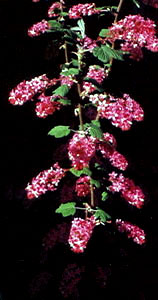
Red-Flowering Currant.
Purchase Information:
This book is available on Amazon.
|