Also See: Endorsements and Purchase Information 
TABLE OF CONTENTS
-
CHAPTER 1: INTRODUCTION
Natural History
Naming the Mammals
What is a Species?
-
Where Do Species Come From? Where Do They Go?
How Species Enrich The World
-
Functional Relationships Among Species in Western Oregon
-
The Squirrel
The Fungus
Squirrel-forest Relations
The fungal connection
The truffle connection
The squirrel connection
The pellet connection
-
Scope of the Book
CHAPTER 2: POUCHED MAMMALS, MARSUPIALIA
Opossums, Didelphiidae
Opossums, Didelphis
-
Opossum, Didelphis virginianus
-
CHAPTER 3: INSECT EATING MAMMALS, INSECTIVORA
Shrews, Soricidae
Long-tailed Shrews, Sorex
-
Wandering shrew, Sorex vagrans
Dusky and Yaquina shrews, Sorex obscurus and Sorex yaquinae
Pacific shrew, Sorex pacificus
Marsh shrew, Sorex bendirei
Northern water shrew, Sorex palustris
Trowbridge shrew, Sorex trowbridgei
-
Moles, Talpidae
American Shrew-mole, Neürotrichus
-
American shrew-mole, Neürotrichus gibbsi
-
Western American Moles, Scapanus
-
Townsend mole, Scapanus townsendi
Coast mole, Scapanus orarius
Broad-handed mole, Scapanus latimanus
-
CHAPTER 4: WINGED MAMMALS, CHIROPTERA
Evening Bats, Vespertilionidae
Mouse-eared Bats, Myotis
-
Little brown bat, Myotis lucifugus
Yuma bat, Myotis yumanensis
Long-eared bat, Myotis evotis
Fringed bat, Myotis thysanodes
Long-legged bat, Myotis volans
California bat, Myotis californicus
-
Silver-haired Bat, Lasionycteris
-
Silver-haired bat, Lasionycteris noctivagans
-
Big brown bats, Eptesicus
-
Big brown bat, Eptesicus fuscus
-
Hairy-tailed bats, Lasiurus
-
Hoary bat, Lasiurus cinereus
-
Big-eared bats, Plecotus
-
Western big-eared bat, Plecotus townsendi
-
Pallid bat, Antrozous
-
Pallid bat, Antrozous pallidus
-
Free-tailed Bats, Mastiff Bats, Molossidae
Free-tailed bats, Tadarida
-
Brazilian free-tailed bat, Tadarida brasiliensis
-
CHAPTER 5: HOPPING MAMMALS, LAGOMORPHA
Pikas or Rock Rabbits, Ochotonidae
Pika, Ochotona
-
Pika, Ochotona princeps
-
Hares and Rabbits, Leporidae
Hares, Lepus
-
Snowshoe hare, Lepus americanus
Black-tailed jackrabbit, Lepus californicus
-
Rabbits, Sylvilagus
-
Brush rabbit, Sylvilagus bachmani
Eastern cottontail, Sylvilagus foridanus
-
CHAPTER 6: GNAWING MAMMALS, RODENTIA
Mountain Beaver, Aplodontidae
Mountain beaver, Aplodontia
-
Mountain beaver, Aplodontia rufa
-
Chipmunks and Squirrels, Sciuridae
Chipmunks, Tamias
-
Townsend chipmunk, Tamias townsendi
Yellow-pine chipmunk, Tamias amoenus
-
Ground squirrels, Spermophilus
-
Beechey ground squirrel, Spermophilus beecheyi
Belding ground squirrel, Spermophilus beldingi
Mantled ground squirrel, Spermophilus lateralis
-
Marmots, Marmota
-
Yellow-bellied marmot, Marmota flaviventris
-
Tree squirrels, Sciurus
-
Western gray squirrel, Sciurus griseus
Eastern gray squirrel, Sciurus carolinensis
Eastern fox squirrel, Sciurus niger
-
Red squirrels and chickarees, Tamiasciurus
-
Chickaree, Tamiasciurus douglasi
-
Flying squirrels, Glaucomys
-
Northern flying squirrel, Glaucomys sabrinus
-
Pocket Mice and Kangaroo Rats, Heteromyidae
Kangaroo rats, Dipodomys
-
Heermann kangaroo rat, Dipodomys heermanni
-
Pocket Gophers, Geomyidae
Western pocket gophers, Thomomys
-
Camas pocket gopher, Thomomys bulbivorus
Mazama pocket gopher, Thomomys mazama
Botta pocket gopher, Thomomys bottae
-
True Beavers, Castoridae
True beaver, Castor
-
North American beaver, Castor canadensis
-
New World Mice and Rats, Cricetidae
Harvest mice, Reithrodontomys
-
Western harvest mouse, Reithrodontomys megalotis
-
Deer mice and white-footed mice, Peromyscus
-
Deer mouse, Peromyscus maniculatus
Piñon mouse, Peromyscus truei
-
Woodrats, Neotoma
-
Dusky-footed woodrat, Neotoma fuscipes
Bushy-tailed woodrat, Neotoma cinerea
-
Voles, Arvicolidae
Red-backed voles, Clethrionomys
-
California red-backed vole, Clethrionomys californicus
-
Heather voles, Phenacomys
-
Heather vole, Phenacomys intermedius
-
White-footed vole and tree voles, Arborimus
-
White-footed vole, Arborimus albipes
Oregon red tree vole, Arborimus longicaudus
-
Meadow voles, Microtus
-
Townsend vole, Microtus townsendi
Long-tailed vole, Microtus longicaudus
Creeping or Oregon vole, Microtus oregoni
Gray-tailed vole, Microtus canicaudus
Montane vole, Microtus montanus
California vole, Microtus californicus
Water vole, Microtus richardsoni
-
Muskrats, Ondatra
-
Muskrat, Ondatra zibethicus
-
Old World Rats and Mice, Muridae
Old World rats, Rattus
-
Black rat, Rattus rattus
Norway rat, Rattus norvegicus
-
House mice, Mus
-
House mouse, Mus musculus
-
Birch Mice and Jumping Mice, Zapodidae
North American jumping mice, Zapus
-
Pacific jumping mouse, Zapus trinotatus
-
New World Porcupines, Erethizontidae
North American porcupine, Erethizon
-
North American porcupine, Erethizon dorsatum
-
Coypus, Myocastoridae
Coypus, Myocastor
-
Coypus or Nutria, Myocastor coypus
-
CHAPTER 7: FLESH EATING MAMMALS, CARNIVORA
Dogs and foxes, Canidae
Dogs, coyotes, wolves, Canis
-
Coyote, Canis latrans
-
Red foxes, Vulpes
-
Red fox, Vulpes vulpes
-
Gray foxes, Urocyon
-
Gray fox, Urocyon cinereoargenteus
-
Bears, Ursidae
North American black bear, Euarctos
-
North American black bear, Euarctos americanus
-
Ringtails, Raccoons, and Allies, Procyonidae
Ringtail, Bassariscus
-
Ringtail, Bassariscus astutus
-
Raccoons, Procyon
-
Raccoon, Procyon lotor
-
Martens, Weasels, Skunks, Otters, and Allies, Mustelidae
Martens and fishers, Martes
-
North American marten, Martes americana
Fisher or Pekan, Martes pennanti
-
Wolverine, Gulo
-
Wolverine, Gulo gulo
-
Weasels, minks, and allies, Mustela
-
Short-tailed weasel, Mustela erminea
Long-tailed weasel, Mustela frenata
Mink, Mustela vison
-
Spotted skunks, Spilogale
-
Spotted skunk, Spilogale putorius
-
Striped and hooded skunks, Mephitis
-
Striped skunk, Mephitis mephitis
-
River otters, Lutra
-
River otter, Lutra canadensis
-
Cats, Lynxes, and Allies, Felidae
True cats, Felis
-
Puma or mountain lion, Felis concolor
-
Lynxes, bobcats, and caracals, Lynx
-
Bobcat, Lynx rufus
-
CHAPTER 8: EVEN-TOED HOOFED MAMMALS, ARTIODACTYLA
North American Elk, Deer, and Allies, Cervidae
North American elk and allies, Cervus
-
North American elk, Cervus elaphus
-
Mule deer and white-tailed deer, Odocoileus
-
Mule deer, Odocoileus hemionus
White-tailed deer, Odocoileus virginianus
-
EPILOGUE
APPENDIX 1: COMMON AND SCIENTIFIC NAMES
APPENDIX 2: TABLE OF MAMMALS' LOCATION IN THE NORTHWEST
GLOSSARY
SELECTED REFERENCES
INDEX (Return to Top of Page)
Endorsements:
"Maser's book describes the land mammals of Oregon that live from the High
Cascades [Cascade Mountains] westward, but it also applies to those same
species living in similar parts of California, Washington, and British
Columbia. … Nowhere else, to this reviewer's knowledge, can one find so
much natural history information about so many mammals of the Pacific Northwest,
and it is their natural history that makes the mammals functional parts of
their ecosystems. The importance of habitat and its connectivity is strongly
supported, and rightly so. This work will probably find most use as a supplement
to a field guide, or to a more technical book...."
A. S. Mossman, emeritus
Humboldt State University
Arcata, California,
July/August 1999 issue of Choice
"Mammals of the Pacific Northwest is as much a personal journey as it is a natural history of mammals of the region. Most vertebrate ecologists of
Maser's generation grew up as kids fascinated by the animals around them;
they crawled through bushes, waded in marshes, and caught everything that
came within reach. Few have remained naturalists because science, even vertebrate
science, has rapidly moved in the direction of rigorous hypothesis testing,
experimental design, and high powered statistical analysis. There seems to
be little place for naturalists in this new climate, and that is our loss.
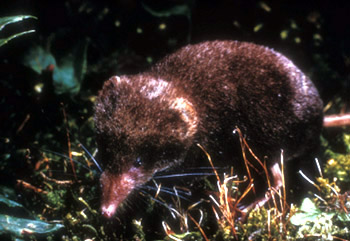
Pacific shrew
"Few people, scientists or otherwise, have had as extensive and intensive studies and personal interactions with as many mammalian species as Maser.
For that reason alone, the book is a treasure trove of fact, observation,
and supposition, from the diets of bats to observations of personality
differences among individual shrews. In this book, Maser presents a lifetime
of observations from a distance to up-close and personal. As Maser himself
says in the introduction: 'I have now spent over thirty years in a consummate
love affair with science—mostly studying mammals in the wild.... I
have over many years learned to know them.' Indeed he has.
"Mammals of the Pacific Northwest is not a field guide, and it doesn't pretend to be one, although most of the information found in field guides is present
in this book as well. It is a taxonomically arranged natural history of these
animals, interspersed with some delightfully poignant and occasionally hilarious
remembrances of particular individual mammals or events, and as such is
remarkably readable. Because it is written from the naturalist's perspective,
this is the book that the serious student of mammals should read before going
out in the field to observe, trap, or study mammals. To borrow from current
vernacular, this book helps one to 'get inside' an animal's head, an ability
often lacking in current generations that haven't had the luxury of many
years of patient first-hand observation.
"Maser's objective was to reach a general audience, and to share his life-long love affair with Pacific Northwest mammals both by presenting his vast storehouse of life history knowledge and by telling interesting (if not endearing) stories of individual animals he has known. I think he has succeeded. Readers will get an enhanced view of what otherwise would be a series of entries in a
field guide; I believe this was Maser's intent. As a professional ecologist, this would be the first source I would want to read if I wanted to learn more about a mammal I planned to study."
Bruce E. Coblentz
Department of Fisheries and Wildlife
Oregon State University
Corvallis, OR
Northwest Science 73:140-141 (1999)
"While legislators were busy in Olympia [Washington] trying to dismantle I-655, the citizens' initiative that prevents bear baiting and sport hunting
of cougar with hounds, I cast my lot with the animals and curled up with
'Mammals of the Pacific Northwest.' This engaging new compendium, the result
of 25 years of fieldwork by Corvallis research scientist Chris Maser, covers
the natural histories of scores of creatures in our region.

Gray-tailed meadow mouse
"This is not some dry field guide. Maser is not only a scientist but a first-rate raconteur, and he combines good, solid scientific data regarding any given animal's biological development, diet, habitat, and so on, with intriguing firsthand observations on behavior. After a lifetime of doing whatever it takes to study his subjects—whether climbing trees, hunkering down in the bushes, or crawling along on all fours—Maser has collected a passel of interesting experiences.
"Some of the scenarios even have included his own unwitting participation: There was the time he and his raccoon companion committed a faux pas at his mother's bridge party, for example, or the time he crashed a deer 'kegger.' And then there was the unforgettable evening when he slept—inadvertently—with a skunk.
"The text is sprinkled generously with black and white photos, [from] which ... you will learn more than you ever could have imagined about the characteristics of various animal droppings...."
Barbara Lloyd McMichael
Bookmonger
Tacoma [Washington] News Tribune
February 28, 1999
"On an elk-hunting trip up Hells Canyon years ago, the weather was far too warm to drive elk from the distant rim.
"We'd been dropped for a week by a jet boat, essentially trapping us with nothing to do nearly 3,000 feet below the elk herds.
"So desperate were we for distraction that we seized the opportunity for challenge the night a mouse munched Skeeter's candy bar.
"The late 'Skeeter' Dykstra was a longtime hunting partner with diabetes, which ultimately took his life. Candy bars were a night-time snack to stabilize his condition.
"When we were awakened by the loud 'thwack' of a stick that Skeeter swung at the mouse (and missed), it was the start of a memorable contest to see who could trap the most rodents around camp in the name of saving Skeeter's midnight rations.
"Years later, as I became more environmentally conscious, it occurred to me we'd interrupted the order of life in and around that small clearing on the banks of the Snake River.
"How much, though, became clear only recently when I read a new and valuable reference book: 'Mammals of the Pacific Northwest, From the Coast to the High Cascades,' by Chris Maser....
"Maser's compelling, well-written and easily understood scientific tome details behaviors and life patterns of animals found in four separate Western Oregon zones.
"True, the 60-year-old naturalist doesn't discuss the mice we trapped in the canyon more than two decades ago. But his description of Western Oregon mammals suggest natural cycles we might have inadvertently altered.
"Mice, of course, are important prey, especially at the outset of winter, for raptors trying to keep from starving and young carnivorous mammals learning to hunt.
"But their burrows also affect surrounding vegetation, and their feces carry and spread seeds.
"I'd have been laughed out of camp at the time, but perhaps it would have been better for Skeeter to simply store his snacks in a nibble-proof container and leave the industrious mice alone.
"Maser punctuates his book with anecdotes from decades of close study of the animals he writes about. They are exhilarating escapes from the scientific explanations.
"In the end, Maser contends in a conveniently brief and effective lecture that humans must do more to recognize the connectivity of the natural world.
"'The decision about the quality of habitat in Western Oregon belongs to us, of course, the adults of the world,' he concludes. 'But the consequences of our decisions we irrevocably bequeath to those generations we call 'the future.'"
Bill Monroe
The Oregonian
December, 31, 1998
"When reading through the species accounts in the book,
it is apparent that Maser has spent years making careful observations
of many of these animals. He is a research scientist in ecology and natural
history, and his writing reveals an obvious connection to his subject. Although
the book is not filled with rigorous scientific fact, with his many personal
observations he gives the reader real insight into the lives of the animals.
It is evident that nature had an early impact on Maser and probably inspired his
life's work at a young age.
"The book is quite readable and informative, and is not merely a description of the natural history and biology of the animals it represents, but an
insight into Chris Maser's years as a scientist and naturalist.... If you
are someone who likes to curl up in a chair with a good book, then
buy Maser's book."
Alison Keple
Marine Mammal Research Unit
Department of Zoology
University of British Columbia
Vancouver, B.C., Canada
Discovery, Summer 2000
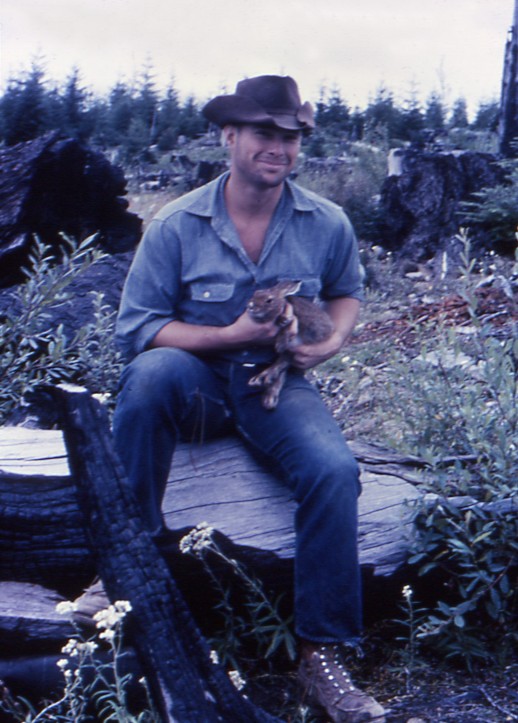
While a graduate student, I helped with a study of snowshoe hares.
"The classic Peterson field guides Mammals and Animal Tracks are excellent references and cover all of North America. But for a much more intimate look into most of our mammals, try Mammals of the Pacific Northwest by Oregon biologist Chris Maser. ...there are in-depth accounts ... from bats to bobcats. Not a hollow, glossy coffee table book, this has extensive details of how these critters live, eat, procreate and die, making it an excellent reference for amateur naturalists and anyone who loves wild mammals. Amusing anecdotes (like drunken deer or 'Mighty Shrew') help lighten the tone."
Bryan Nichols
WaveLength Paddling Magazine
"If you live in the Pacific Northwest and want to identify the wild mammals you see, this book is very helpful. However, there is a lot more to the book than just good descriptions of mammals. Stories about each creature bring to life the animals you may never encounter. Chris Maser is clearly fond of his subjects and tries hard to help the reader get a feel for their lives. It is fun to just open this book at random and read a few pages about vole or bat you never knew existed. I have several mammal identification books. This is the best one."
Anonymous
on Amazon
"As do many books with subjects attempting to cover the entire 'Pacific Northwest,' this book focuses primarily on a certain area of the PNW. In this book's case, it's Oregon (no offense at all to this wonderful state). The photos are all small, black-and-white, and obscure. There are MANY photos of feces in this book. While it's helpful to know feces identification, it's more important to identify mammals by species identification. Perhaps I'm lucky, because I get to see more actual animals in the wild, rather than only their droppings. Some mammals in the book are not even pictured at all. Some of my friends have never even seen a nutria (coypus) or a marten in the wild, so pictures of them (and other animals) would have been helpful and more aesthetically pleasing to them. I've seen wolves in eastern Washington and a brown stage black bear in western Washington which the book does not address. On the other hand, the bat and shrew sections were extensive and thorough. Overall, the book is interesting and is scientifically well-organized. Included is ample, specific information on habitat, behavior, and breeding."
Anonymous
on Amazon 2002
"Tremendous amount of information on the mammals in the Pacific Northwest. A lot more than in most guides."
Ruth M.
on Amazon 2020
"This remarkable book offers an intimate look at the life histories and habitats of mammals in the Pacific Northwest. In introducing the region's mammals, Chris Maser combines current scientific knowledge with personal accounts and anecdotes drawn from over a quarter century of fieldwork in Oregon. For each species of mammal, the book provides a physical description and detailed information on distribution, habitat, and behavior, and it is illustrated with over 100 photographs of mammals and their tracks, dens, nests, and young."
King County Lake Stewardship Program
Department of Natural Resources and Parks
Water and Land Resources Division
Seattle, WA

Mantled ground squirrel
"I wish this book had more photos of the animals, because it is otherwise really fine. Don't let the amount of text put you off, there is interesting and readable information here for the amateur naturalist. Food, footprints, droppings, nests. Hard to say no to this one."
Oregon Library Association
"This is a great source of information about habits and habitats of many of the mammals found in the Pacific Northwest. Very readable style, with up-to-date information. Chris Maser is a biologist who has written many Forest Service reports on northwest fauna, so is a very credible source and draws much on his own field experience in this book."
Mark D. Jordahl
Conservation Education
"My students have raved about your books (Mammals of the Pacific Northwest) and how much they have helped them to connect and understand complex science principles. They relate to the relevant applications you provide that are things happening right around them. It has helped them understand the importance and complexity involved in respecting and protecting the living systems that support and sustain the planet."
Cindy Haws,
Assistant Professor of Science
Umpqua Community College,
Roseburg, OR
"If you're in the Pacific Northwest, Chris Maser's book, Mammals of the Pacific Northwest gives excellent info on the mammals of the region (several pages on each), including regionally-specific habits, food preferences, good sign-tracking info, interesting personal stories, etc...."
Jason Knight
Tracking & Mammals Moderator
Wilderness Awareness School
"I have examined several books on the natural history of mammals but found this the most informative and readable. The book focuses on western Oregon but would still be a useful reference in anywhere in our region. Maser devotes several pages to each species, covering feeding habits, reproduction, life cycle, and other details. The treatment of small mammals, which many books gloss over, is particularly strong. I would not call this a tracking book, but Maser does include photos of tracks and other sign. To me this is much more than a reference book as I found it very fascinating reading. This is a must for your library."
http://dirttime.ws/Notebook/Books.htm
"I've had this book for years but picked it up again today to read about moles and got caught up reading about other creatures.
"This is a truly wonderful reference book for western Oregon mammals. The author intersperses scientific information with personal stories about his experiences with each animal he describes. He is from the Corvallis area so the many of these stories take place within 50 miles of where I live. I go back to the book as reference over and over. I think it is out of print, but it is well worth tracking down if you live in West of the Cascades in Oregon or Washington."
Karl Anderson
Goodreads
http://www.goodreads.com/book/show/8442573-mammals-of-the-pacific-northwest
"This is a truly wonderful reference book for western Oregon mammals. The author intersperses scientific information with personal stories about his experiences with each animal he describes. He is from the Corvallis area so many of these stories take place within 50 miles of where I live. I go back to the book as reference over and over. I think it is out of print, but it is well worth tracking down if you live West of the Cascades in Oregon or Washington."
Nancy—recommended to me by Karl Anderson
Goodreads
"This remarkable book offers an intimate look at the life histories and habitats of mammals in the Pacific Northwest, from the coast to the high Cascades. In introducing the region's mammals, Chris Maser combines current scientific knowledge with personal accounts and anecdotes drawn from over a quarter century of fieldwork in Oregon. The book covers the natural history of eighty-nine mammals in Oregon, seventy in Washington, sixty-seven in British Columbia, and eighty-three in Northern California. For each species of mammal, the book provides a physical description and detailed information on distribution, habitat, and behavior. A keen observer of animal life, Maser relates his own encounters in the wild—from a rare, firsthand description of how shrews hunt and kill their prey to a tour of a mountain beaver's burrow—to help readers better understand the animals he has come to know. Maser delves into the secrets of how mammals live and explores the dynamic relationships between the mammals of the Pacific Northwest and their habitats.
"Intended for general readers and students, Mammals of the Pacific Northwest provides a fascinating natural history of the region's wildlife. The book is illustrated with over one hundred photographs of mammals and their tracks, dens, nests, and young."
Description from Canadian Edition
Univeristy of British Columbia Press
(Return to Top of Page)
Purchase Information:
This book is available on Amazon.
|