Also See: Endorsements, Maser's The Redesigned Forest reconsidered, Dis-endorsement, and Purchase Information
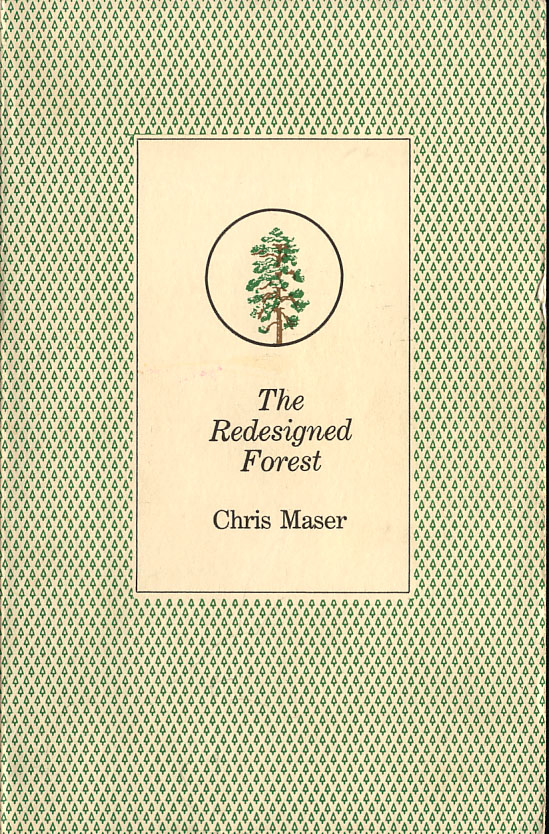
TABLE OF CONTENTS
-
PREFACE
PART ONE—NATURE'S DESIGN OF A FOREST VERSUS OUR DESIGN OF A FOREST
Nature designed a forest as an experiment in unpredictability.
We are trying to design a regulated forest.
Nature designed a forest of long-term trends.
We are trying to design a forest of short-term absolutes.
Nature designed a forest with diversity.
We are designing a forest with simplistic uniformity.
Nature designed a forest with interrelated processes.
We are trying to design a forest based on isolated products.
Nature designed a forest in which all elements are neutral.
We are designing a forest in which we perceive some elements as good, others bad.
Nature designed a forest to be a flexible, timeless continuum of species.
We are designing a forest to be a rigid, time-constrained monoculture.
Nature designed a forest over a landscape.
We are trying to design a forest on each acre.
Nature designed Pacific Northwest forests to live 500-1200 years.
We are designing a forest that may seldom live 100 years.
Nature designed Pacific Northwest forests to be unique in the word—25 species of conifers, 7 major ones, the longest lived and the largest of their genera.
We are designing a forest based largely on a single-species, short rotation.
Nature designed a forest to be self-sustaining, self-repairing.
We are designing a forest to require increasing external subsides—fertilizers, herbicides, pesticides.
-
PART 2—AS WE THINK SO WE MANAGE
Technology, science, and uncertainty
Special cases and common denominators
Short-term economic expedience
-
Greece
Mediterrenean
Middle East
Forest decline
-
Of automobiles and forests
On genetics and Swiss bank accounts
A forest is cyclical, not linear
What you see is not the whole story
Ace is low
Where are you?
There is no magic hinge
Planning—our half-used data
-
PART 3—CHANGE, WHY ARE WE AFRAID OF IT?
No "enemies" are "out there"
The crack in the sidewalk
To judge or not to judge
decisions, Decisions, DECISIONS
A good decision
Of captains and cooks
Hidden agendas
Emotion and logic
A gift from Elisabeth
Our human experience
-
PART 4—WE ARE AS FREE AS OUR IMAGINATION
Sustainable forests = sustainable harvests
Who old growth
If we really want the spotted owl to survive
And God gave us only so much water
The enemy in the courtroom
Alice in objectiveland
"…it was then that I carried you."
Restoration forestry
The future is today
APPENDIX 1
APPENDIX 2
LITERATURE CITED (Return to Top of Page)
Endorsements:
Chris in conversation with my wife last evening, I suddenly realized how much I have learned from you, and deeply you've penetrated my life.
I am 59. In the early 90's, I discovered The Redesigned Forest while running tree-planting operations in northern Ontario. I read it a few times and then gave it to someone who I thought may benefit from it. I bought another copy, then gave it away too. I am now on my fifth copy of the book, and who knows, I may give it away as well.
There are several profound messages in the book that have become core to my worldview and to my philosophy. I may have come to these ideas in other ways eventually—I have a degree in ecology, I travel a lot, I study culture and religion, and try to understand the place of man, my group, relative to, and as part of the world as a whole—but whatever seeds you planted in me when I was a young man really took root and flourished. Thank you very much!
-- James Cook
Toronto, Canada
"The principles set out in The Redesigned Forest are not restricted to forests, but are equally applicable to any other natural ecosystem on planet earth, and Chris Maser's erudite and yet easy-to-follow writing and his keen perceptiveness are a welcome and refreshing breeze in a world in need of hope."
Dr. S. C. J. Jourbert
Warden, Kruger National Park
Skukuza, South Africa
"This is a very personal book of the author's philosophy of life and love for our planet and all things. It is full of … ecological wisdom: must reading for those who care (or should care) about sustaining our forest. My dream is that Chris Maser's ideas will take root, grow, and flourish."
Barry R. Flamm
Chief Forester
The Wilderness Society
"In The Redesigned Forest, Chris Maser issues a serious, sensible, and sensitive challenge to the way in which the forest lands of northwest North America are managed. For too long, the land and its vast and diverse resources have been viewed as conquerable and inexhaustable. Also for too long, its management and use have been shaped by policies encouraging short-term, economic gain. In this process, man has isolated himself from the land. Secure in towns and cities far away from the forest lands, politicians and technocrats pay no serious attention to the devastating consequences of their undertakings.
"The human species is an interdependent and integral part of the land, the water, the air, the animals, and all of Creation. As it nourishes us, as it clothes us, and as it warms us, the earth is like our mother. And as we owe to our mother, we have a duty and responsibility to protect it for the generations yet to come."
Edward John
Tribal Chief
Carrier Sekani Tribal Council
Prince George, B.C., Canada
"Chris Maser calls for a new way of envisioning the forest … one that is broad enough to allow for a multitude of values and perspectives. Indeed, in the long run, the very survival of humanity will depend on this. In helping us to look through his eyes at the integrations found within a forest ecosystem, Maser is, at the same time, helping his readers to become more cognizant and sensitive to the need for personal and cultural integration and transformation. For it is by learning to heal ourselves and our relationships with each other that we can learn to heal the world about us. Thus, it is only in the restoration of human dignity that we begin to have restoration forestry."
Dr. Duncan M. Taylor
Environmental Studies Program
University of Victoria,
Victoria, B.C., Canada.
"The work of Chris Maser, a former BLM employee, stands as perhaps the most striking testament to the ferment that is now taking place within the federal land agencies. The Redesigned Forest is a provocative, highly readable call to arms for fundamental reform of our policy toward old-growth forests. Maser's creative thinking and writing surely will figure prominently in the comprehensive reassessment that we are now undergoing in regard to our treatment of the nation's forest lands."
Charles F. Wilkinson
Professor of Law
University of Colorado at Boulder.
"I'm about half way through Chris Maser's THE REDESIGNED FOREST, having recently finished a related book THE FOREST AND THE TREES, by Gorden Robison. In both cases I believe that the authors view forest management as art, not science, but feel that science may be of some use to help better understand the dynamics of the interrelated systems and subsystems that constitute forests. Maser's illustrations are anecdotal, I believe, and not meant to be comprehensive. His appeal is for us to admit how very little we really know about the environment and the many interrelated, dynamic systems that make it up. Maser's style is romantic, and will no doubt cause consternation among some scientists. His plea is for synthesis, much like that made by Allan Bloom in THE CLOSING OF THE AMERICAN MIND in his highly controversial criticism of American education. In arriving at this synthesis, Maser would want us to manage forests after considering as many interrelationships as possible, tracking consequences of action broadly across space and through time. I like the book, while recognizing some human failings in its construction—Maser just didn't have ten years to wait to try to perfect his plea, the Old Growth in the Pacific Northwest might be gone by then. But there are those who take a far dimmer view—read on."
Dave Iverson
Eco-Watch
"In The Redesigned Forest, Chris Maser has written for the layperson an accessible, gentle, and non-confrontational book that casts serious doubt on current forest management policies in British Columbia. … The Redesigned Forest deserves a prominent place in the discussion currently underway as British Columbians try to develop a sustainable forest management policy to take us into the 21st century."
Gary Swann
Pacific Tribune,
Vancouver, B.C., Canada.
"Author, lecturer, and international consultant on forest management issues, Chris Maser of Corvallis, Oregon, is known to some as the 'Ghandi of the Forest.' He was employed as research biologist for 12 years with the Bureau of Land Management and is considered an expert on ancient or old-growth forests. His informed, nonadversarial approach toward environmental issues and competing interest groups has won him the respect of conservationists, government agencies, and members of the timber industry. … Your book, 'The Redesigned Forest,' seems to be written as much by a poet as a scientist."
Will Hornyak
The Stewards' Journal.
"When it was first published, Chris Maser's book almost immediately became a classic, a 'must read' for those concerned with forest issues. The work is a far-reaching discussion of our cultural mindset and how it has led to destructive, inappropriate forestry. In the environmental debate the forestry industry frequently poses the familiar conundrum "We depend on the forests; why would we destroy them? The Redesigned Forest explains why.
"Understanding the book requires an introduction to Maser himself. A long time Bureau of Land Management employee working on forest issues, Maser began as a research biologist. He is now a private consultant on sustainable forestry. Maser knows his subject intimately and speaks with passion.
"The first section of the book compares what a forest actually is with what we believe it to be. Our conventional forestry treats forests as simple wood fibre factories, a sort of tall lawn that serves only one purpose. Forests are actually complex coevolved, coadapted systems that operate to modify moisture regimes, temperature, air movement and physical geography, that build, hold, and alter soil, and that incidentally produce wood fibre.
"It is this conflict between our perspective and biological reality that is the focus of the following sections. Maser looks at how a combination of economic expedience, short term need, and our patterns of thinking have determined forestry policy and practice, in this century particularly, with only casual consideration of the biological realities of forests.
"In the third section Maser leaves forestry per se to discuss human psychology and philosophy, with a view to understanding our decision-making process. In particular, he discusses the influence of some idealists, who would have us believe that people in positions of authority make decisions based on careful consideration of the facts.
"It is also in this section that Maser starts to lay the basis for envisioning forests in a new way, through a combination of scientific fact, personal philosophy and a deep love for the natural world.
"In the final section Maser offers alternatives to our current practices, realistic and practical approaches that would allow for sustained forest use in a nondestructive way.
"The Redesigned Forest is not definitive, nor detailed in a technical sense. Its vision is more epic, its ideas embracing. For those who wish to understand why a tree farm is not, and can never be a forest, Maser continues to be a 'must read.'"
Mike Kaulbars
Peace and Environment News
"Chris Maser's most prominent book was published in 1988 and is entitled The Redesigned Forest. He uses the notion of a 'redesigned' forest in order to differentiate his approach from the 'forest management' school of the U.S. Forest Service. Maser worked for twenty years as a research scientist for the Forest Service, and includes many useful details in his book. The biggest problem with his book, however, is the patronizing, evangelical polemic dominating almost every page. The evangelical tone threatens to discount his most valuable insights. A characteristic passage appears at the end of the introduction:
Three things I would like you to understand before you read this book. First, I recognize, as we strive to maintain sustainable forests, that we are faced with the constant struggle of accepting change and its accompanying uncertainties and this often gives rise to fear of the future. We must therefore be gentle with one another and do whatever we do with love because there are no "enemies" out there, only frightened people. Second, ideas change the world; people change ideas. And people must change before ideas will change. Third, all we have in the world as human beings is each other; if we lose sight of each other, we have nothing.
"Certainly the emotional proselytizing of this passage is quite different from the German perspectives I have shown earlier.
"This is not to discount Maser's work altogether. The main point of his book, and he often refers to the history of German forestry for support, is that a forest consists as much of what is below the ground as it does of what is above. To 'redesign' the forest, then, involves an increased awareness of root structures, water run-off patterns, planting strategies, and soil toxicity. His argument is that 'we must have a sustainable forest before we can have a sustainable yield.' We cannot allow our forests to be treated as 'short-term tree plantations.' The evidence he gives in support of these arguments is impressive, and I can recommend them to you. The problem is the nearly fundamentalist quality of his agrarian utopianism."
Dr. Steven Taubeneck
Environmental Ethics: Sustainability, Competition, & Forestry
The Centre for Applied Ethics, University of British Columbia
"Every forest landowner should be encouraged to read The Redesigned Forest, a book by Chris Maser, a professional forester living in Oregon. (Unfortunately, this excellent book is no longer in print, but may be found in libraries or used-book stores.)"
Ramon L. Kent
Stewardship Forester
Lacey, Washington
"I'm an ex-journalist, now a sustainable tourism development consultant. When I retrained by taking a degree at the University of Victoria in 1988-1990, your Redeisgned Forest was the most influential textbook I read (and it wasn't on any course list). You put words to many of the basic concepts (like the value of soil) that had previously been only intuitive."
Bruce Whyte
Community Visions Consulting, Inc.
British Columbia, Canada
"my name is mia, i am a student at Ramapo college of new jersey. i have read your book The Redesigned Forest for my forest resources class. let me first tell you how much your book moved me. it made me realize how often i am not truly 'present' and it also boosted my self esteem to read about the part of your book that discusses fear of not being accepted by others if they happen to catch you being the REAL you, if you should ever happen to slip out of character. your book has reinstilled my beliefs, taught me a great deal about how the forest operates as a whole, made me understand myself and very much so others, all while being an incredably enjoyable read. and at no time did you assume to know ALL of the answers, which i respect. i would like to deeply thank you. you have a wonderful soul and are very talented in expressing your ideas which is so very important given that we are in a point of time where the spreading of knowledge and ideas outside of what is presented in mainstream media are our best chance for change. namaste, i honor the light inside of you that is within us all. yours truly and sincerely, mia. "
"Chris Maser's (1990) book The Redesigned Forest unquestioningly was influential in challenging the status quo [of silviculture] in the Pacific Northwest, and in turn, the country. This debate, still very much ongoing, has caused the maturing forestry profession to reexamine its core values."
Robert S. Seymour
Hutchins Professor of Forest Resources,
Department of Forest Ecosystem Science,
University of Maine, Orono
"I read The Redesigned Forest some 20 years ago, and found it a seminal book. It totally changed the way I think about forests and our relationship to them."
Larry K. Fried
Publisher,
Natural Choice Directory
for the Willamette Valley, OR
"The author clearly explains the natural design of a forest, and how science and technology have tried to change that design. If you're interested in knowing about forests, this book is a important addition to your library."
L. Landry
Virginia
"A brilliant, timeless work that is ignored by foresters and silviculture professors. This is a landmark book that details how forestry must be done to ensure sustainability of timber as well as everything/everyone who lives in the forest. The 'New Forestry' and 'Exemplary Forestry' are nothing but terms used to deceive the public into supporting forest destruction. Maser's work is the key ... but how do we get the governments to enforce true best management practices in an industry that only cares about profit?"
M. A. White
NW Connecticut
"Best read on forest ecology and biological community systems. I first read Redesigned Forest 14 years ago and have reread it twice and thought it was still out of print. I wrote to the author to encourage its reprinting because it is a classic; a scientific treatise written as literature. Apparently he listened even though he has since gone on to chronicle his life as a uniquely successful community organizer. This book is my favorite ecology, nature book and is without peer. It is skillfully written, readable in a single sitting; reading as if a novel and traces the interconnected life of a forest as a living organism from level of protozoa to spotted owl. Spotted owl? Maser is too modest so I volunteer to be his apologist. He is a microbiologist. He is the foremost expert on old growth forest in the Pacific NW and possibly the world. He helped to initiate and supplied the science to confirm the spotted owl controversy that helped to save the last remaining 5-10% of virgin old growth timber stands in the NW.
"...This book should be the foundation textbook to high school and university introductory (lower division) biology classes. It is a must read for all people interested in global warming, economics, indicator species, ecology and saving the Earth."
Anonymous
on Amazon
(Return to Top of Page)
Maser's The Redesigned Forest reconsidered:
Chris Maser, an ecologist at the very center of the ecosystem management movement, wrote a book in 1988 entitled The Redesigned Forest in which he outlined some significant problems of how we see the world, and—based on this vision (in his view, erroneous)—what we may have done to forests (and in by implication, to other kinds of ecosystems). Many of these changes, while motivated by good intentions, he believes are irreversible. In the course of the book, he made a number of parallel contrasts which attempted to show what forests actually are or do—to describe the inherent nature of forests—with how humans generally and erroneously, see forests, and how they attempt to make them into something else. Generally speaking, his point is that this "something else" is either impossible, unlikely, or undesirable. I found his imagery powerful.
However, while I sympathize with his objective and agreed to most of his points, his way of speaking about Nature—in particular as if Nature is conscious of itself, and as if it had intentions or "ends in mind," is not as compelling as it might have been. In my view, his anthropocentric language merely substituted one ideology and all its inherent confusion, for another. Moreover, I think he makes several other more serious ontological errors, which may be important. Ontology is a philosophical term for our axiomatic and, by definition, unprovable premises/ beliefs/ assertions about what the world is made of, and how it works. Of course, most if not all of these premises are based on human experience, insights, and intuitions but for a variety of complex reasons cannot be settled for all time. In short, these notions may be wrong and we can never be certain, although we may have sound indications one way or the other. Ontology deals with such notions as time, space, substance, thing, motion, and change. Needless to say, these notions are important but are generally taken for granted. As we come to grasp the significance of ecosystems and our place in them, believe me, these notions are of the utmost importance. Indeed, I believe that many of our recent natural resource controversies and their social implications result in large part from a profound confusion and error concerning the ontological possibilities of ecosystems.
In any event, since I thought that Maser's original impulse was a worthy one, I took the liberty of modifying and adding to these contrasts. I don't herein show his original set, nor itemize the specific reasons why I think each one of these phrasings might be better. But in the least, the first statement of each of my modified contrasts—in place of talking of what Nature is, or does, or thinks states in its place, some ontological "fact" about the world and how this ontological "fact" manifests itself in forest ecosystem realities or possibilities. The manifestations I mention follow Maser's lead in most cases. The second half of the contrast then speaks about how current forest practices or attitudes either ignore or misunderstand what these ontological "facts" suggest is doable—or more often, what may not be doable. Further, I use the phrase "we would…" to suggest the utterance of a well-meaning but willful child who wished something were otherwise.
What do you think?
1. Forests and ecosystems are ever-changing continuums of living and non-living things and processes—embedded in time.
We would design forests as rigid monocultures—suspended from time.
2. Forests are complex landscapes whose patterns reflect crucial underlying structure and process.
We would design forests, which largely ignore these structures and processes and their imperatives for pattern.
3. Forests are mixtures of living and non-living things and processes which are:
Self-organized.
Self-repairing.
Self-sustaining.
Dynamic yet relatively stable.
We would design forests requiring frequently destructive, ultimately impossible subsidies of energy, fertilizer, pesticides, even water.
4. Diversity is a fundamental property of forests and other ecosystems, and emerges for many "reasons" at many system levels—from chemical compounds through species and communities, to galaxies.
We would design forests with simplistic uniformity for only one "reason": Efficient Commodity Production.
5. The world and its forests reflect various laws of impossibility—of physics and thermodynamics—not trends.
We would design forests that vainly ignore these laws for short-term, and increasingly trivial cravings.
6. The world and its forests are co-evolving and interrelated systems of things and processes meeting many "ends" and functions. Energy and materials which "fuel" these processes do not merely pass through but remain as wastes with subsequent effects on processes.
We would design forests imagining that they can give up huge portions of their matter and energy for only human ends, to be consumed elsewhere, largely ignoring the effects of waste on subsequent processes.
7. Ecosystems and forest are inherently value-neutral, and we are largely ignorant of their functional and dynamic interrelations.
We would presume to judge which components and processes are good or bad—which is to say, which ones suit current human values and moral vision.
8. The direction of the world and its forests is largely unpredictable and their moral implications ambiguous—but it works! What is more, it so far still includes us.
We would design machine-like forests, forever altering the possibilities of a robust creation.
The general tenor of these contrasts is that while we have come to know much about ecosystems, that with enough time we may learn more, that human needs are compelling, and that we must unavoidably use forests to meet these needs, there are a number of things beyond our ken. Such limits exist not only because of the limited ability of humans to understand and to steer the world, but especially because of the co-evolving nature of human and biospheric interactions. Our efforts will always come up short because our observing and theorizing will always be behind the state of the world—knowledge will always lag a largely emergent reality, influenced if not set in motion by our own economically motivated action.
Yet, these statements are not meant to suggest that nothing can be done. On the contrary, we have already seen in our efforts across a wide range of natural and social sciences, using a wide-ranging set of material and social criteria, and over an amazingly short time, that we can accomplish much. Confronting such limits may help reduce if not eliminate the hubris that characterizes much recent boasting about our ability to steer ecosystems toward, in the current vernacular, a "desired future condition." For sustainability is a dialectic notion; that is, one that—due to continuous and often emergent change in both the material and social world—can never be settled for all time. It is a notion forever chasing its own tail. Moreover, it is a notion confounded with moral and aesthetic dimensions for it embodies human ends and purpose as well as material understanding. While we may be forced by material necessity to redesign forests, caution will be a useful virtue indeed. Claims to have developed sustainable forest practices are unwarranted, more than likely will always be so, and most dangerously, continue to obscure possibilities and delay necessarily tentative but more realistic actions.
Dennis Bradley
Forest Economist
North Central Forest Experiment Station
USDA Forest Service
St. Paul, MN
Eco-Watch April 21, 1994
(Return to Top of Page)
Dis-endorsement:
The Redesigned Forest is an intriguing title!
Brief review comments on the back cover suggest that it is a book of personal values and philosophy concerning management of forest lands. The author, Chris Maser, was educated as a vertebrate zoologist, and he worked for the USDI Bureau of Land Management as staff biologist from 1975 to 1987. An ardent advocate of "old-growth" values, he has achieved acclaim among lay groups concerned with preservation.
The book comes at a time when Pacific Coast forests and associated industries are in transition, and considerable confusion and polarization exists in society regarding management of our nation's forests. Thus, people who wish to understand this transition, controversy, and possible solutions may think the book will provide useful background. It does foster insight regarding the positions taken by some sectors, and bits of natural history, popular psychology, and philosophy are interwoven throughout the text. As a statement of personal values and philosophy the book is interesting reading. It raises questions about the sustainability of current management practices and the premises on which they are based, and offers an alternative approach—"Restoration Forestry"—which the author regards as the only true forestry. We recognize that spiritual, aesthetic, and scientific values of old-growth forests are important components of many forest landscapes, and that there is always more to be learned about forest ecology and management. However, we also know that many outstanding examples of intensive and successful forestry programs are found in the Douglas-fir region and elsewhere. Because Maser's book questions such current management and the scientific basis for it, we agreed to provide this review.
General:
The main theme of The Redesigned Forest is that we need a broad commitment to a sustainable forest and that sustainable limits are set by the forest (not by people). Maser believes that young-growth forests are not sustainable under current management practices, and suggests that they must be "healed with humility, love, understanding, and patience." He seems to regard reliance on natural processes (especially those operative in old-growth stands) as the most desired, if not sole, path to such healing and sustainability. He is also skeptical of intensive management practices and seems to view them primarily as agents of additional stress rather than as relievers of natural stress or as means of channeling natural processes to enhance a variety of forest uses and values, including sustainability. Virtually all rational people would agree that sustainability of forests is essential to the well-being of humankind. Moreover, the debate over naturalistic ideology is commonly replayed in situations similar to the present controversy, with people favoring positions along the entire spectrum from unbridled natural development and succession to very intensive manipulation. Unfortunately, the philosophical discussion in this book is based upon some serious misconceptions and it contains a great deal of misinformation about forest management and its scientific basis. Such problems can only add to the current confusion surrounding the forest management controversy. Thus, we will comment on selected examples of these misconceptions.
Examples of Misconceptions
Forest decline—To support his contention that young-growth forests as currently managed are not sustainable, Maser cites a "growing evidence of decline in productivity over large areas of intensively managed forests" throughout the world.
The author questions the simplification he associates with "European plantation management," and resurrects the example of the infamous "Saxony spruce sickness" reported in the 19th century when Norway spruce was planted on central European sites cleared of low-quality, natural stands of mixed hardwoods. Although plantations grew well in the first rotation, growth declines sometimes were seen in the second. The cause, according to Maser, was the high demand and withdrawal of ecological resources wrought by intensive plantation management. In fact, the real cause was discovered decades ago (Holmsgaard et al. 1961). Spruce declined principally on sites with poor internal drainage. Removing the more deeply-rooted hardwoods from such bottomland sites and the eventual collapse and plugging of old root channels led to a rise in the winter water table. Such waterlogging of soil in winter forced the spruce into a shallow rooting habit, leaving them prone to drought stress when water tables dropped in the summer. In short, "Saxony spruce sickness" was not due to any inherently bad property of monocultures, but simply to a poor match of species with site.
"The forests of central Europe are dying," Maser says (p. 69), and he speaks of the Waldsterben, or forest decline syndrome of West Germany, as a logical consequence of the cumulative effects of intensive plantation management. Most objective forest scientists, however, say Waldsterben is caused by several factors including pathogens, air pollution, and soil chemistry. Moreover, most planted forests of Europe that have been under management for centuries are growing vigorously except for those downwind from air pollution centers. Maser complains that outside investigators "list a variety of reasons for Waldsterben...(but) not one of them is directly connected to intensive management." He dismisses their conclusions without ever considering that they—with far more experience and training in plant and soil science than he—may be right. Evidence that intensive plantation management per se is causing a general decline is scant (Powers et al. 1990). However, where it has been demonstrated, i.e. South Australia (Keeves 1966), the causes are known and can be avoided (Squire et al. 1985). Recent research shows that some plantations in the United States actually are aggrading in fertility (Nowak et al. 1989), and that growth declines evident in some plantations since the 1960's may trace simply to maturation of the plantations or to abnormal temperatures in recent years (LeBlanc et al. 1987). Research also suggests that even-aged spruce and fir stands in New England allegely showing growth decline are actually growing as expected for mature stands of the region (Hornbeck et al. 1986).
Maser also cites Sheffield and Cost's (1987) report of apparent growth declines in the southern pinery. A careful reading of their more extensive document (Sheffield et al. 1985), however, indicates that the decline is far from general. In fact, decline seems to be centered on natural (not planted) stands of pine growing on nonindustrial private ownerships (which are generally unmanaged or managed with low intensity!). Limited sampling in plantations on more intensively managed ownerships indicates that growth rates there are stable, or have even increased. The author also sidesteps the voluminous data collected by scientists in the eastern United States showing how planting abandoned, worn-out farmlands with pure stands of conifers has arrested soil loss and restored soil fertility and site productivity through carbon and nutrient cycling.
The truffle connection—One of the most interesting parts of the book concerns Maser's work on rodent-truffle-tree relationships in Pacific Coast forests. Truffle fungi appear to be an important food source for flying squirrels and other small rodents, and spores of the hypogeous mycorrhizal fungi are disseminated by these mammals. In linking such observations to mycorrhizal formation and forest productivity, however, the author does not acknowledge that there is much diversity and considerable functional redundancy among mycorrhizal populations. Neither does he point out that many mycorrhizal species are wind-disseminated, nor does he provide any evidence of reductions in populations of truffle fungi caused by management activities. The ubiquity, diversity, and vigor of native mycorrhizal fungi are apparent in the lack of long-term benefits when nursery seedlings intentionally innoculated with selected mycorrhizae have been outplanted on typical forest sites (Ruehle et al. 1981, Bledsoe et al. 1985, and Shaw et al. 1987).
Genetic bankruptcy—Maser believes that genetic improvement programs are "redesigning" the forest, and he sees three major drawbacks: (1) genetically improved stock lacks predictability and may fail sometime in the future; (2) improved, faster-growing trees will produce wood with large cells and less heartwood, thereby altering recycling rates and other ecological processes; and (3) improved stock has less genetic variability and thus is less adaptable to changing environmental conditions (e.g. global warming).
The author assumes that geneticists wish to restructure profoundly the genetic makeup of forest trees and are able to do so. Neither assumption is true. Geneticists estimate that the current selection process can achieve only about a 10- to 15-percent
improvement in growth rate (Zobel and Talbert 1984). Most forest trees, Douglas-fir included, are amazingly variable genetically—so variable that no significant reduction in that variability has been found in stands containing only a few trees that survived wildfire or in progeny originating from seed tree cuttings. Geneticists are keenly aware of the pitfalls of breeding for homogeneity. In the Douglas-fir region, for example, 200 to 300 parent trees have been selected in each of 81 breeding zones for a total of more than 22,000 individuals (Northwest Tree Improv. Coop. 1988). Furthermore, these first-generation orchards and clone banks will be in operation well into the next century, at which time improved stock from them will be reaching maturity. Options for adjustments in selection criteria will remain open.
Selection criteria are for rapid growth rates, improved form, disease resistance, and, sometimes, high or low specific gravity. Amounts and proportions of heartwood and related effects on ecological functions will be much more influenced by rotation age than by genetic improvement programs. Parent trees within a seed orchard are selected from a wide variety of environmental conditions within their local geographic area, which allows humans to assist natural adaptation by, for instance, moving planting stock from southern seed orchards to more northern areas for out planting if the regional climate warms.
Young-growth management—Perhaps the most disconcerting of the misconceptions and misinformation contained in this book are statements regarding management of young-growth forests. Maser asserts that premises of current young growth management (p. 105-106) are based on experience with old-growth and that they are false. In fact, more than 80 years of research on growth and development of young-growth forests, managed and unmanaged, provide the scientific basis for current management and yield projections in the Douglas-fir region. Forest fertilization is referred to as "plea bargaining" (p. 138), equating it to one of the stages of dying described by Kubler-Ross (1969). In essence, Maser suggests that as a person may bargain with God to reverse a terminal illness, forest managers may choose to apply fertilizers rather than alter existing beliefs and management practices. He fails to inform readers that on two-thirds of Douglas-fir sites, stands respond to nitrogen fertilizer and that 40 years of both empirical and basic research on forest nutrition have enabled managers to enhance the productivity on hundreds of thousands of forested acres.
Despite many references to liquidation and exploitation, the author makes no mention of the fact that the Pacific Coast is one of the few places in North America in which the forest products industry logged the original forest and never left. The industry invested in and has already harvested substantial amounts of the second forest; moreover, third-generation stands appear to have better early growth than their predecessors. We see no justification for impugning or rejecting the silvicultural basis for such sound management programs.
Restoration forestry—Maser's answer to the problems he perceives with sustainability is to restore the forest to its original condition. His suggested approaches include maintaining some of the original, unmanaged stands and including an "old-growth" rotation in management cycles, as we might use a rotation of different species in crop rotation systems. He refers to liquidating the natural forest as though all old growth will be cut, and makes no mention of the extensive acreage of old growth forest permanently set aside in Research Natural Areas, Wilderness Areas, and National Parks. Nor does he mention the substantial areas of public land that are already being managed on long rotations (150+ years) for the express purpose of developing old-growth stand conditions for wildlife habitat, aesthetics, and other forest values. Moreover, the ideas presented are restricted and simplistic in comparison with the broad range of objectives and management practices being discussed and applied in the Pacific Northwest and elsewhere. For example, many forest managers are purposely including snags, hardwood groups, and large woody debris in intensively managed stands. These structural characteristics of old forests appear to provide important habitat components for some wildlife species. Further, retaining coarse woody debris may help sustain or enhance soil productivity-particularly on dry, harsh sites (Harvey et al. 1987, Jurgensen et al. 1979).
Overall
The premise underlying much of Maser's philosophy is that forest ecosystems function through precariously-balanced interdependencies, where alteration leads inexorably downward. He dramatizes this early in the book (p. 14) by recounting the crash of a helicopter and loss of life because a simple screw had been removed and not replaced during servicing. The analogy—that "for want of a 'screw', a forest will be lost"—seems illogical and inappropriate when applied to ecosystems. Helicopters are designed to be cause-and-effect mechanical systems. Forest ecosystems, however, contain much functional duplication and have many compensatory interactions. Centuries of experience and much scientific investigation in moist temperat forests seem to provide far more support for a premise of forest resilience to disturbances associated with current management activities than for Maser's philosophy of extreme fragility.
The Redesigned Forest does speak to values and philosophies of forest management but it bears little resemblance to A Sand County Almanac (Leopold 1949) and other such works. Whatever the cause (ignorance, intent, or both), the scientific credibility of The Redesigned Forest suffers from an abundance of inaccurate and selectively-chosen information as well as illogical speculation. It therefore does little to foster accurate understanding of existing and proposed management options for biodiversity, wildlife habitat, site productivity, and other resource considerations. If the book has value, it is that it provides documentation of some of the philosophical views as well as the misconceptions that have become part of the current controversy. Reading the book will alert forest managers, forest scientists, and other knowledgeable people concerned with the forest environment to the nature and magnitude of the misinformation. We urge informed readers to take a more active part in overcoming this problem.
Philip S. Aune (program manager),
William W. Oliver (project leader), and
Robert F. Powers(principle silviculturist)
all of the Pacific Southwest Research Station,
U.S. Forest Service in Redding, CA;
James R. Boyle and John C. Tappeiner
professors in the College of Forestry,
Oregon State University, Corvallis;
Dean S. DeBell (project leader),
Pacific Northwest Research Station
U.S. Forest Service in Olympia, WA;
Chadwick D. Oliver (professor),
College of Forest Resources,
University of Washington, Seattle.
LITERATURE CITED
Bledsoe, C. S., K. Tennyson, and W. Lopushinsky. 1982. Survival and growth of outplanted Douglas-fir seedlings inoculated with mycorrhizal fungi. Can. J. For. Res. 12:720-723.
Harvey, A. E., M. F. Jurgensen, M. J. Larsen, and R. T.
Graham. 1987. Decaying organic materials and soil quality in the Inland Northwest: a management opportunity. U.S.D.A. Forest Service Gen Tech. Rept. Int-225. 15 p.
Holmsgaard, E., H. Holstener-Jorgensen, and A.
Yde-Anderson. 1961. Bodenbildung, Zuwachs und Gesundeitszustand von Fichtenbestanden erster und zweiter Generation. 1. NordSeeland. Forstl. Forsogsv. Danm. 27: 167 p.
Hornbeck, J. W., R. B. Smith, and C. A. Federer. 1986.
Growth decline in red spruce and balsam fir relative to natural processes. Water, Air, and Soil Pollut. 31:425-430.
Jurgensen, M. F., M. J. Larsen, and A. Harvey. 1979. Forest soil biology-timber harvesting relationships. U.S.D.A. Forest Service Gen Tech. Report Int-69.
Keeves, A. 1966. Some evidence of loss of productivity with successive rotations of Pinus radiata in the south-east of South Australia. Aust. For. 30:51-63.
Kubler-Ross, E. 1969. On death and dying. Macmillan Publ. Co., Inc., New York, NY. 289 pp.
LeBlanc, D. C., D. J. Raynal, and E. H. White. 1987.
Acidic deposition and tree growth: I. The use of stem analysis to study historical growth patterns. J. Environ. Qual. 16:325-333.
Leopold, A. 1949. A Sand County almanac, and sketches
here and there. Oxford Univ. Press, New York. 226 p.
Northwest Tree Improvement Cooperative. 1988. 1988 progress report for local cooperative programs. R. Quam, comp. Corvallis, OR. 77 p.
Nowak, C. A., J. P. Shepard, R. B. Downard, Jr., E. H.
White, D. J. Raynal, and M. J. Mitchell. 1989. Nutrient cycling in Adirondack conifer plantations: is acid deposition an influencing factor? Water, Air, and Soil Pollut. 48:209-204.
Powers, R. F., D. H. Alban, R. E. Miller, A. E. Tiarks,
C. G. Wells, P. E. Avers, R. G. Cline, N. S. Loftus, Jr., and R. O. Fitzgerald. 1990. Sustaining productivity in North American forests: problems and prospects. p. 49-79 In Sustained productivity of forest land, S.P. Gessel, D.S. Lacate, G. F. Weetman, and R.F. Powers, eds. Proc. Seventh N. Am. For. Soils Conf., Univ. British Columbia, Vancouver. 24-28 July, 1988.
Ruehle, J. L. 1983. The relationship between
lateral-root development and spread of Pisolithus tinctorius ectomycorrhizae after planting of container-grown loblolly pine seedlings. Forest Sci. 29:519-526.
Shaw, C. G., III, R. C. Sidle, and A. S. Harris. 1987.
Evaluation of planting sites common to southeast Alaska clear-cut. III. Effects of microsite type and ectomycorrhizal inoculation on growth and survival of Sitka spruce seedlings. Can. J. For. Res. 17:334-339.
Sheffield, R. M., and N. D. Cost. 1987. Behind the
decline. J. For. 85:29-33.
Sheffield, R. M., N. D. Cost, W. A. Bechtold, and J. P. McClure. 1985. Pine growth reductions in the southeast. U.S.D.A. For. Serv., Resource Bull. SE-83, 112 p. Southeast. For. Exp. Stn., Asheville, NC.
Squire, R. O., P. W. Farrell, D. W. Flinn, and B. C.
Aerberli. 1985. Productivity of first and second rotation stands of radiata pine on sandy soils. II. Height and volume growth at five years. Aust. For. 48O:127-137.
Zobel, B. J., and Talbert, J. T. 1984. Applied forest tree improvement. John Wiley and Sons, New York. p.448.
(Return to Top of Page)
Purchase Information:
This book is available on amazon.
|
|