Also See: Endorsements and Purchase Information
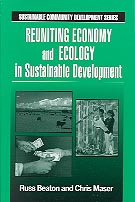
TABLE OF CONTENTS
-
CHAPTER 1: ORIGINS OF SUSTAINABILITY
Beginning Perspectives
Modern Origins of the Growth Debate
The Problem and Its Crisis
Science and the Natural World
Questioning the Economics of Growth
The Institutional and Political Imperative
Toward a Philosophy of Sufficiency
Summarizing and Looking Forward
CHAPTER 2: ECONOMICS FROM THE GROUND UP
Background
In Search of Community Economic Theory
Some Historic Economic Phases
-
Cave Economics
Tribal Economics
Village Economics
City Economics
National Economics
Global Economics
-
Summing Up
CHAPTER 3: VISIONING, COUNTING, AND VALUING
-
Two Economic Visions
-
The Throughput Economy
-
The Spaceship Earth Model
-
Assessing the Scorecard
-
Three Problems with Gross Domestic Product
Attempting to Change
-
The Language of Values
-
Two Broad Categories
Alternative World Views
The Pyramid of Values
Demand and Values—A Final Note
-
CHAPTER 4: RECOGNIZING THE GROWTH ETHIC IN YOUR COMMUNITY
-
Economics of Looking at Your Community
-
What Are the Costs of Growth?
Who Pays and Who Benefits?
-
Recognizing the Rhetoric
-
Prosperity Begins at Home
Don't You Appreciate Cultural Diversity?
Think of Your Children
Livability and the Price of Housing
The Landowner as King
-
Slow versus Rapid Growth
Conclusion
A Personal Note
CHAPTER 5: RECYCLING IN THEORY AND PRACTICE
Recycling in Practice
Recycling as Impossibility-Irreversibility
The Symbolism of Recycling
An Example: Seeing Things Whole
Extracting the Principles
CHAPTER 6: TOWARD PRACTICAL USE OF SUSTAINABILITY
A Citizen's Simulation
Practical Difficulties with Conceptual Sustainability
Why Does It Matter?
The Political "Middle Way"
Marginal Sustainability
CHAPTER 7: GLOBALIZATION AND SUSTAINABILITY
Globalization Is Here, Now, and Real
Profits: The Driving Force Behind Globalization
Prospecting for Profits
Financial Feeding Frenzy
The Defense of Globalization
Sustainability versus Globalization
ENDNOTES
BIBLIOGRAPHY (Return to Top of Page)
Endorsements
"Puts forth a vision of melding ecology and economy into a unifying concept of social-environmental sustainability. Discusses how the biological sciences have lost their spiritual foundation, and explains how our view of the world is fragmented and distracted from the processes that maintain the viability of the ecosystems we depend on. Recommends strategies for sustainability both locally and globally."—©Book News, Inc., Portland, OR.
"This is a book that belongs in every thinking-person's library. Clear and elegant writing in addition to the critical topic makes this a book to give all your friends!"—Jeanne Enders, Lake Oswego, OR.
"Fight against it as I might, having been trained as an economist, I view much of the world through markets and statistics. Luckily, I have had mentors in the profession who question the narrow vision of standard doctrine. This book serves such a purpose. For non-economists, this book reminds sustainable development advocates that their concepts must make economic sense; for economists, it questions perceived truths, and looks beyond traditional economics to alternative perspectives for important answers."—Christopher Meier.
"Reuniting Economy and Ecology in Sustainable Development is a recent contribution to the series on the various aspects of sustainable development, where 'community' focuses on the primacy and quality of relationships among people sharing a particular place in their environment. The book attempts to meld ecology and economy into a unifying concept of social-environmental sustainability. Reuniting Economy and Ecology discusses how biological sciences have all but lost their spiritual foundation and explains how our view of the world is fragmented and distracted from the processes that produce and maintain the viability of the ecosystems on which we depend for survival. The authors also show that the cause of environmental problems arises from within ourselves and makes evident that we are asking science to answer questions concerning social values.
"Russ Beaton is Professor of Economics at Willamette University in Salem, Oregon. He coauthored Oregon's nationally recognized legislation on land-use planning and has long been involved, both as researcher and citizen, in affairs dealing with energy, the environment, land use, and local and regional economic issues. Chris Maser spent over twenty years as a research scientist in natural history and ecology in forest, shrub steppe, subarctic, desert, and coastal settings. Maser is an independent author as well as an international lecturer and a facilitator in resolving environmental disputes, vision statements, and sustainable community development. He is also an international consultant in forest ecology and sustainable forestry practices."—Environmental Law, Vol. 29, 1999.
"Reuniting Economy and Ecology in Sustainable Development is a recent contribution to the series on the various aspects of sustainable development, where "community" focuses on the primacy and quality of relationships among people sharing a particular place in their environment. The book attempts to meld ecology and economy into a unifying concept of social-environmental sustainability. Reuniting Economy and Ecology discusses how biological sciences have all but lost their spiritual foundation and explains how our view of the world is fragmented and distracted from the processes that produce and maintain the viability of the ecosystems on which we depend for survival. The authors also show that the cause of environmental problems arises from within ourselves and makes evident that we are asking science to answer questions concerning social values."—R. Meltz, Questia. (Return to Top of Page)
Purchase Information:
This book is available on amazon.
|