Also See: Editor's Note, Endorsements, and Purchase Information
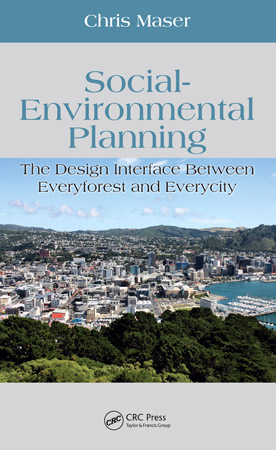 TABLE OF CONTENTS
-
-
INTRODUCTION
ENDNOTES
PART I: THE HUMAN DIMENSION OF SOCIAL-ENVIRONMENTAL PLANNING
-
CHAPTER 1: HOW WE THINK
FRAME OF MIND
-
Our Shared Personality Traits
Our Thoughts, Motives, and Actions Are All We Can Ever Control
Knowledge Is Some Version of the Truth
-
FRAME OF REFERENCE
-
Perception
Paradox
Unity
-
EVERYONE IS RIGHT FROM THEIR OWN PERSPECTIVE
SUMMATION
ENDNOTES
-
CHAPTER 2: LANGUAGE AND COMMUNICATION
THE PROCESS OF COMMUNICATION
-
Speaker
Listener
-
BARRIERS TO EFFECTIVE COMMUNICATION
-
Lack of a Common Experience
Use of Abstractions
Inability to Transfer Experiences From One Situation to Another
-
SUMMATION
ENDNOTES
-
PART TWO: NATURE'S RULES OF ENGAGMENT IN SOCIAL-ENVIRONMENTAL PLANNING
-
CHAPTER 3: THE LAW OF COSMIC UNIFICATION
UNDERSTANDING THE LAW OF COSMIC UNIFICATION
THE INVIOLATE BIOPHYSICAL PRINCIPLES
-
Principle 1—Everything Is a Relationship
Principle 2— All Relationships Are Productive
Principle 3—The Only True Investment Is Energy from Sunlight
Principle 4—All Systems Are Defined By Their Function
Principle 5—All Relationships Result In a Transfer of Energy
Principle 6—All Relationships Are Self-Reinforcing Feedback Loops
Principle 7—All Relationships Have One Or More Tradeoffs
Principle 8—Change Is a Process of Eternal Becoming
Principle 9—All Relationships Are Irreverisble
Principle 10—All Systems Are Based On Composition, Structure, and Function
Principle 11—All Systems Have Cumulative Effects, Lag Periods, and Thresholds
Principle 12—All Systems Are Cyclical, But None Are Perfect Circles
Principle 13—Systemic Change Is Based On Self-Organized Criticality
Principle 14—Dynamic Disequilibrium Rules All Systems
-
SUMMATION
ENDNOTES
-
CHAPTER 4: BASIC COMPONENTS OF DESIGN
COMPOSITION
-
Everyforest
Everycity
-
STRUCTURE
-
Everyforest
Everycity
-
FUNCTION
-
Everyforest
Everycity
Forest-City Interface
-
SYSTEM-ALTERING DISTURBANCES
THE NEGOTIABILITY OF CONSTRAINTS
-
Scientific Questions
Social Questions
-
SUMMATION
ENDNOTES
-
CHAPTER 5: HABITAT, THE LANGUAGE OF BOUNDARIES
FOOD
-
Everyforest
Everycity
-
WATER
-
Everyforest
Everycity
The Common Denominator Between Everyforest and Everycity
-
SHELTER
-
Everyforest
Everycity
The Common Denominator Between Everyforest and Everycity
-
SPACE
-
Everyforest
Everycity
-
PRIVACY
-
Everyforest
Everycity
-
CONNECTIVITY
-
Connectivity in Everyforest
Water
Food
Shelter
Space
Privacy
Connectivity in Everycity
Of Everyforest and Everycity
-
SUMMATION
ENDNOTES
-
CHAPTER 6: PATTERNS ACROSS THE LANDSCAPE
RELATIONSHIP AND PATTERN
-
Patterns in Everyforest
Patterns in Everycity
-
SUMMATION
ENDNOTES
-
CHAPTER 7: INFRASTRUCTURE
THE ENERGY INTERCHANGE SYSTEM
-
Energy Interchange in Everyforest
Energy Interchange in Everycity
Intersecting Rings
Intersecting Rings and Cities
Intersecting Rings and Forests
-
CONDUITS OF INTERCHANGE
-
Conduits in Everyforest
Conduits in Everycity
A Lesson Ignored in "Conduit 101"
-
THE SERVICE CONNECTION
-
Services in Everyforest and Beyond
Services in Everycity
Who Benefits, Who Pays?
-
THE TRANSPORTATION SYSTEM: EFFICIENCY OR EFFECTIVENESS?
-
Transportation in Everyforest
Transportation in Everycity
-
THE IMPORTANCE OF BACKUPS
-
Backup Systems in Everyforest
Backup Systems in Everycity
-
SUMMATION
ENDNOTES
-
PART THREE: SHARED RELATIONSHIPS BETWEEN EVERYFOREST AND EVERYCITY
-
CHAPTER 8: CUMULATIVE EFFECTS, LAG PERIODS, AND THRESHOLDS
THE TRIAD IN EVERYFOREST
THE TRIAD IN EVERYCITY
-
Yesteryear's Town
Today's City
The Cumulative Effect of Today's Cities
-
SUMMATION
ENDNOTES
-
CHAPTER 9: AGE AS AN ARCHIVE OF HISTORY
AGE AS AN ARCHIVE
-
Age as an Archive in Everyforest
Age as an Archive in Everycity
-
WHY SAVE THE OLD?
-
The Value of Saving Old Forests
The Value of Saving Old Parts of a City
-
SUMMATION
ENDNOTES
-
CHAPTER 10: ECOLOGY AND ECONOMY
GROSS DOMESTIC PRODUCT
-
Gross Domestic Product in Everyforest
Gross Domestic Product in Everycity
-
ECO-EFFICIENCY
-
Eco-Efficiency in Everyforest
Eco-Efficiency in Everycity
-
GENUINE ECONOMIC INDICATORS
-
Genuine Economic Indicators in Everyforest
Genuine Economic Indicators in Everycity
-
REUNITING ECOLOGY AND ECONOMY
-
Making Our Economic System People Friendly
Making Our Economic System Environmentally Friendly
-
SUMMATION
ENDNOTES
-
PART FOUR: A CENTURY FOR HEALING
CHAPTER 11: TOWARD SOCIAL-ENVIRONMENTAL EQUALITY IN A DIVERSE WORLD
THE BEGINNINGS OF INTERNATIONAL, SOCIAL PARITY
REVISITING THE NOTION OF DEVELOPMENT
SUMMATION
ENDNOTES
-
CHAPTER 12: SOCIAL-ENVIRONMENTAL PLANNING IN SPACE AND TIME
OUR DAILY RELATIONSHIPS
-
Intrapersonal
Interpersonal
Between People and the Environment
Between People in the Present and Those of the Future
-
EVERYFOREST AND EVERYCITY AS A LIVING TRUST
-
A Living Trust as a "Big Idea"
Everyforest is a Biological Living Trust
Everycity is a Cultural Living Trust
-
LONG-TERM, SOCIAL-ENVIRONMENTAL PLANNING
-
Planning Increments
Where to Begin?
Vision
Goals
Challenges of Long-Term Planning
Philosophical Underpinnings
Scientific Underpinnings
Conceptual Framework
Policy
Leadership
Behavioral Constraints in
Long-Range, Social-Environmental Planning
Benefits of long-term, social-environmental planning
-
SUMMATION
ENDNOTES
-
CHAPTER 13: CHALLENGES FOR SOCIAL-ENVIRONMENTAL PLANNING
CULTURAL CAPACITY
CONTROLLING OUR HUMAN POPULATION
WHAT WE INTRODUCE INTO THE ENVIRONMENT
RENEWABLE ENERGY
OPEN SPACE
-
Water
Communal Space
Surrounding Landscape
Agricultural Cropland
Forest Land
Riparian Areas
Floodplains
-
CENTRALIZED GENERALIZATION
THE URBAN-WILDLIFE INTERFACE
SUMMATION
ENDNOTES
-
CHAPTER 14: WHERE LEADERS DARE TO GO
ENDNOTES
GLOSSARY
APPENDIX (Return to Top of Page)
Editor's Note for the "CRC Press" Book Series, Social-Environmental Sustainability:
If we want a world of true social-environmental quality to live in, we must change our materialistic values and habits-and be persistent in that change. We must reach beyond where we feel safe and dare to move ahead, despite the fact that perfect knowledge will always elude us.
There are no biological short cuts, technological quick fixes, or political hype embodied in our current symptomatic thinking that can mend what is broken. Dramatic, fundamental change in the form of systemic thinking is necessary if we are really concerned with bettering our quality of life-even that of next year.
Social-Environmental Sustainability is a series of books designed to examine our human-caused, global problems in terms of nature's biophysical support systems and to propose sustainable solutions that will move society toward an ecologically sound environment and a socially just culture. As such, each book in this series will be thoughtfully selected because it must add a new dimension to the resolution of our problems-not just repackage old ideas.
My purpose in writing this book is to help people comprehend the commonalities and reciprocities among the biophysical patterns and functions that activate and maintain Everyforest and Everycity. With this understanding, people can determine what they can do to personally leave this magnificent planet a little better for subsequent generations, while simultaneously improving conditions for themselves. After all, Earth is a biological living trust, of which we, the adults, are the immediate trustees. In turn, the children of today, tomorrow, and beyond are the beneficiaries of our decisions and actions, which become the circumstances of their lives-and we allow them no voice in the decision-making process.
Chris Maser, Series Editor
(Return to Top of Page)
Endorsements:
"With the environment, climate change, and global warming taking center stage in the national debate, the issues seem insurmountable and certainly unsolvable at the local level. Written by Chris Maser, international consultant on forest ecology, sustainable forestry practices, and sustainable development, Social-Environmental Planning: The Design Interface Between Everyforest and Everycity focuses on community based solutions, emphasizing how the heavy lifting of sustainability will always be done inside existing cities and communities. Based on the author's forty years of experience, the book covers the sustainability of the planet and its population when dealing with climate change.
"The book provides an in-depth understanding of the commonalities of pattern between Everyforest and Everycity. Maser suggests that before changes can be made, society must adapt to the circumstances of global climate change as they already are, and then determine what we can do to stabilize global climate as effectively and quickly as possible. He explores the reciprocal interface between communities and the landscape and how, when this interface is recognized and understood, it can create solutions that work. With this comprehension, people can adapt to the present and begin determining what they can do now to leave the planet a little better for each generation."—Publishers Description.
"The book provides an important and unique perspective on the strong relationships and parallels between human-made systems and structures and other natural systems and structures. The convergence of the social and physical sciences; of science and spirituality; of art and science and of other previously isolated fields of endeavor and belief will be, I believe, the hallmark of this century. Chris's book elegantly weaves together two such realms of thought and understanding. I have been an urban planner since 1971 and have read many books relative to planning and development. I have not yet read a book or article, which provides this much-needed framework for planners, public officials engaged in community development, and systems thinkers. I believe this book will make a significant contribution to the existing conceptual frameworks used by urban, regional, and natural resource/environmental planners while laying the groundwork for an emerging multi-dimensional, multi-disciplinary, highly integrative thought system."—Jane Silberstein, Bainbridge Island, Washington.
"I've been assigned to index your new book for Taylor and Francis. I just wanted to let you know what a great pleasure it has been to READ your book as well as index it. I truly appreciate how you bring together insights from philosophy and literature to bear on the ecological worldview. Now, if only we could get policymakers in Washington to have the same profundity of insight!!!"— Sybil Ihrig , L.Ac., HMA, San Marcos, CA.
"With the environment, climate change, and global warming taking center stage in the national debate, the issues seem insurmountable and certainly unsolvable at the local level. Written by Chris Maser, international consultant on forest ecology, sustainable forestry practices, and sustainable development, Social-Environmental Planning: The Design Interface Between Everyforest and Everycity focuses on community based solutions, emphasizing how the heavy lifting of sustainability will always be done inside existing cities and communities. Based on the author's forty years of experience, the book covers the sustainability of the planet and its population when dealing with climate change.
"The book provides an in-depth understanding of the commonalities of pattern between Everyforest and Everycity. Maser suggests that before changes can be made, society must adapt to the circumstances of global climate change as they already are, and then determine what we can do to stabilize global climate as effectively and quickly as possible. He explores the reciprocal interface between communities and the landscape and how, when this interface is recognized and understood, it can create solutions that work. With this comprehension, people can adapt to the present and begin determining what they can do now to leave the planet a little better for each generation."—Wageningen UR Library Catalogue.
"Social environmental planning: The design interface between everyforest and everycity explores the sociological and structural relationships and interactions between nature, culture, and urban environments in the face of global climate change. Using a charismatic discourse and witty convictions, Chris Maser argues that the functionality of nature's design can be and has been used as a guiding framework to build human communities. He draws parallels between the forest as a complex bionetwork and the built environment. He illustrates the similarities in social decision making processes, cause, and effect tendencies, and the spectrum of colour invoked through arts and culture for humans, as compared with nature's aesthetic appeal and displays (xvii). Maser weaves in the concept of narrative: '[w]e humans compose the broad shapes of a cultural storyline by using words to convey colours of meaning we mix on a palette of syntax' (xvii). He stirs a melange of hard scientific spice, design savvy, and sociological criteria in contrasting a forest with a city.
"Maser introduces the human dimension, discussing perspective, personality, and motivations. He relates language and communication to how humans experience, acquire, and process knowledge. He outlines a 'frame of reference' and illustrates variances in our perceptions of truth based on cultural evolution. Finally, he weaves this into our potential for interpersonal cooperation and communication in moving towards a sustainable future. Maser then maps 14 biophysical principles and offers suggestions for application through design methods. These principles outline the commonalities and fundamental tenets of relationships and of how the world functions or operates: flows of energy; constancy of change; the interdependency of systems; and, the cyclical dynamic between structure and function. Here, Maser contrasts 'everyforest' with 'everycity' through closer examination of design elements, such as composition and constraints; habitat components, such as boundaries and access to resources; landscape patterns; and infrastructure. His chapter on infrastructure echoes the concept of urban metabolism (Heynen et al. 2006) and systemic interplay through which humans attempt to control, bend, and shape nature in community design. Maser's most interesting observation is that landscape patterns 'give visible expression to the heretofore-unseen desires that reside in our human psyche' (p. 102). Maser's ability to bridge scientific theory with social psychology is compelling.
"Identity is comprised of both the natural and constructed environment, which centres around shared relationships and values. The three central tropes here include: cumulative human effects; age as historical archive; and, the relationship between ecology and economy. Maser argues 'psychological maturity, which equates to mental/emotional health, is our capacity to recognize and account for what best serves the whole in any given situation' (p. 235). The concluding part of the book serves to contextualize social environmental planning at the microscale. Sustaining the quality of life, ensuring human health, and moving away from global social and economic polarity have become major considerations in urban planning over the past decade. Maser suggests that a shift in social wealth will lead to social parity (p. 221). He outlines here the basic concepts of and challenges facing environmental planning, which include interpersonal connections, renewed commitment, and effective leadership.
"Not since Jones and Cloke's Tree cultures: The place of trees and trees in their place (2002 [Oxford, New York, NY]), and Konijnendijk's The forest and the city: The cultural landscape of urban woodland (2008 [Springer, Dordrecht, Germany]), has there been a text so comprehensively bridging urban nature, human culture, and structural process. Maser challenges his reader to set aside common assumptions about placing blame, for example with respect to environmental degradation, on one aspect or component of society. Instead, he suggests that the system must evolve collectively. Through practical logic, scientific explanation, and unparalleled social insight and intuition, Maser breaks down stereotypical absolutisms in environmental management planning.
"Social environmental planning sets out to establish new ways of examining and understanding the relationship between nature's processes and the design of human communities. It is, however, weak on looking at social divisions among humans, where readers expecting an exhaustive theoretical analysis will be disappointed; Maser could here be profitably read against some of the urban political ecology literature (Heynen et al. 2006 [ In the nature of cities: Urban political ecology and the politics of urban metabolism. Routledge, New York, NY] ). However, the book offers excellent insight into the relationships, functions, and paralleles of forests and cities; human behaviour; and also management planning strategies. Set against the backdrop of global climate change, this book reinforces the idea that thinking about green nature in relation to urbanization processes is integral to developing sustainable communities in the interest of human health and quality of living."—Adrina Bardekjian The Canadian Geographer, 56 (2012):385-386.
(Return to Top of Page)
Purchase Information:
This book is available on amazon.