Also See: Table of Contents, Endorsements, Special Acknowledgments, and Purchase Information
FOREWORD
We depend on forests, yet we know less about them than we should. Forests are thought by many to be economic engines, providing wood for construction and fuel and wood chips for paper. Even as tourists, we view forests as a vista of trees, cloaking mountains and valleys. In this book, three wise men tell us there is much more that we should be seeing when we look at forests. Concentrating on their personal experiences in the Pacific Northwest of North America and southeastern Australia, they take us on an ecological and historical tour to open our eyes to the complexity of the ecological webs that support forests.
Ecologists have been like most people in ignoring the soil. It has been left to agricultural scientists and some foresters to begin to investigate soil ecology. The stimulus to these investigations has been largely practical—why are these crops not growing? And how can we increase tree growth for more wood production? The role that fungi play in plant growth was not understood in the 1800s when agricultural scientists began to investigate limiting factors in soils. Fungi were viewed as decomposers and disease agents, and not as essential players in the growth of living plants. An astute botanist, Albert Bernhard Frank, professor of plant pathology at the Royal College of Agriculture in Berlin, suggested in 1885 that mycorrhizae formed by certain fungi with tree roots were in fact beneficial to the plants. Many scientists rejected his idea for decades that the association of fungi with roots was a mutualistic symbiosis, or a win-win interaction, because it was against the conventional wisdom that fungi caused disease and decay. Clearly, some fungi might be nice to eat, but that was as far as it went.
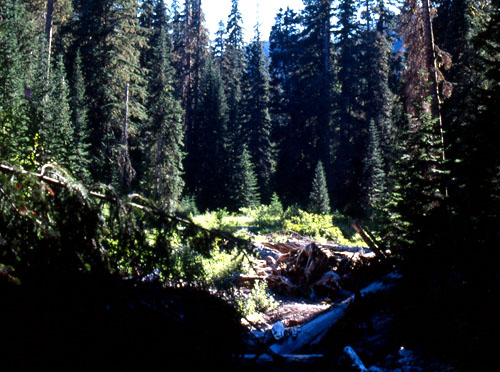
Coniferous forest in the Pacific northwestern United States
During the last fifty years, ecologists have begun to appreciate the significance of fungal mutualisms to tree growth and survival. Coupled with this growing interest has been the application of aboveground ecological ideas to soil biology. Predator-prey dynamics, competition, dispersal, and community dynamics are all the subject of soil biology today.
We were even late to discover the importance of fungal foods to animals. Many examples in this book will capture your imagination because they seem so highly improbable. How do California red-backed voles in old-growth forests of the Pacific Northwest survive on a diet that is almost entirely composed of fungi? How does the long-nosed potoroo of eastern Australia locate the great diversity of fungal species in its diet when many of these species fruit below ground? Read on and you will discover a wealth of information on how animals use fungi as food sources.
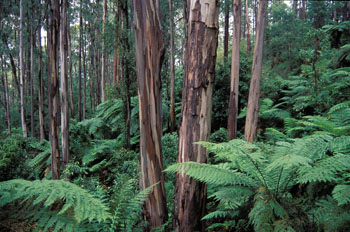
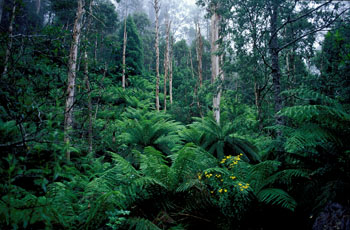
Eucalypt forests in southeastern Australia
But it is events going on above ground that equally strongly affect the forests of the earth. Harvesting of trees has created a fragmentation of forests across the landscape, and we only dimly understand the implications of forest fragmentation for the plants and the animals dependent on them. We replant forests without always appreciating the fungal associations necessary for success. We suppress fires on the mistaken view that fire is a destructive economic force and must be minimized, with the result that our forests accumulate fuel loads that spell disaster if and when a fire is ignited.
The message of this book is that we must view forests as a complex system of interactions. The first message of complex system theory is that you cannot change just one thing. Humans operate with limited scope on the assumption that since they are doing only one thing, it will be easy to rectify if something unexpected happens. The second message of complex system theory is that you cannot easily undo mistakes. Management actions, like fire prevention or its opposite too frequent burning, unleash a cascade of biological interactions that we cannot predict. The eternal optimism of the manager that we know what to do to achieve a short-term goal must be replaced by an ecological realism based on the kinds of complexities you will discover in this book.
There is yet much work to do, and that is another message that flows from this book. The ecologist treats good news stories, like the recent methods for growing one of the world's most expensive fungus, Perigord truffles, in North America, with mixed happiness because the introduction of new species of fungi are not always ecological successes, even if they boost the economy. We should tread lightly on natural systems as we gather the detailed kinds of ecological insights that we find summarized in this book.
The ultimate issue of all of our human interactions with nature is whether what we do is sustainable in the long term. Many business leaders and politicians now use sustainability in "motherhood statements," but if we are serious about achieving this essential goal we must find out what human activities must be started and what must be stopped. Most now seem to agree that stopping the increase in carbon dioxide emissions is an absolute requirement of sustainability, but if we wish to sustain our forests, what do we need to change? This book is a start in answering this very large question on which the world depends more than it appreciates.
The last message of this very readable book is that science is a search of discovery done by interesting human beings turned loose in a new world in which too little is known. There is much more to the forests of the Earth than the Pacific Northwest and south-eastern Australia, and we see a good start here. But it is the tropical forests that remain the great challenge for this century, and I can only hope that some of the readers of this book will be challenged to carry these ideas into forests in other parts of the Earth. Science never stops, and this is a good progress report to see why.
Charles Krebs
Emerits Professor of Zoology
University of British Columbia
Vancouver, Canada;
Fellow Emeritus of Wildlife and Ecology,
Commonwealth Scientific and Industrial Research Organization
Canberra, Australia; and
Adjunct Professor
University of Canberra
Canberra, ACT 2601
Australia
(Return to Top of Page)
TABLE OF CONTENTS
-
INTRODUCTION
Scope of This Book—From the Microscope to Infinity
Forests Are a Study in Complexity
Soil is Every Forest's Foundation
People and Forests Are Inseparable
-
CHAPTER 1: THE FOREST WE SEE
Composition, Structure, and Function
Pacific Northwestern United States and Southeastern Mainland Australia
-
CHAPTER 2: THE UNSEEN FOREST
The Genesis of Soil
-
Physical Weathering
Chemical Weathering
The Addition of Organic Material to Mineral Soil
-
The Living Community within the Soil
-
The Nitrogen Fixers
Scavengers, the Recyclers in the Soil
-
The Environment Is a Seamless Whole
-
CHAPTER 3: TREES, TRUFFLES, AND BEASTS—COEVOLUTION IN ACTION
In the Beginning
Mycorrhizae Enter the Scene
Fungal Nourishment: Decomposition and Symbiosis
-
Global Diversification of Organisms, Unification of Functions
Host Specificity and Forest Succession
Trees, Truffles, and Beasts: Spore Dispersal through Mycophagy
-
CHAPTER 4: OF ANIMALS AND FUNGI
Obligate Mycophagists
Preferential Mycophagists
Casual or Opportunistic Mycophagists
Accidental Mycophagists
Preferences in fungal diets
Invertebrate mycophagists
-
CHAPTER 5: THE IMPORTANCE OF MYCOPHAGY
The Fungal Feast: Nutritional Rewards of Mycophagy
-
Macroelements
Microelements
Proteins and Amino Acids
Carbohydrates
Fats and Fatty Acids
Vitamins
Nutrient Availability, Symbiosis, and Digestive Strategy
Truffle Diversity, the Key to Mycophagist Nutrition
-
Ecosystem Services of Mycophagy
-
Mycophagy Interactions with Soil Moisture
Mycophagy Initiates and Maintains Truffle Diversity
-
CHAPTER 6: LANDSCAPE PATTERNS AND FIRE
Landscape Patterns
The Role of Fire in Forests
-
Fire in the Western United States
Fire in Southeastern, Mainland Australia
Lessons from Byadbo, Mount St. Helens, Omeo, and Beyond
-
The Mycorrhizal Response to Disturbance
The Role of Spore Dispersal by Mycophagy
Emulating Fire Patterns
-
CHAPTER 7: FOREST SUCCESSION AND HABITAT DYNAMICS
Developmental Stages of the Forest
-
Autogenic Succession above Ground
Autogenic Succession below Ground
-
The Dynamics of Habitat
-
Food
Water
Shelter
Privacy
Space
-
Landscape Patterns
-
United States
Australia
Humanity's Fragmentation
-
Equality among Species
-
CHAPTER 8: OF LIFESTYLES AND SHARED HABITATS
A Glimpse of Two U.S. Forests
A Glimpse of Two Australian Forests
Ecological Services of Mycophagous Mammals
-
The Fungal Connection
The Fruit-Body Connection
The Squirrel and Potoroo Connection
The Pellet Connection
Mycophagy as a Basis of Infrastructural Relationships
-
Putting It All Together
-
Partitioning Habitat in the United States
Partitioning Habitat in Australia
Partitioning Food in the United States
Partitioning Food in Australia
Temporal Segregation in the United States
Temporal Segregation in Australia
-
The Importance of Ecological "Backups"
-
CHAPTER 9: LESSONS FROM THE TREES, THE TRUFFLES AND THE BEASTS
Shifting Our Focus
Products and Biological Capital
ENDNOTES
GLOSSARY
-
APPENDIX A: North American Common and Scientific Names
APPENDIX B: Australian Common and Scientific Names (Return to Top of Page)
-
Endorsements:
"The book provides excellent coverage of the symbiosis between trees, fungi, and animals, an overarching theme. . . . Few works take these personal views into account to give such a holistic view of the forested landscape. Highly recommended." Trees, Truffles, and Beasts: How Forests Function is nominated an "Outstanding Academic Title" in the January 2010 issue of Choice Magazine.
"In today's world of specialization, people are attempting to protect the Earth's fragile state by swapping limousines for hybrids and pesticide-laced foods for organic produce. At other times, environmental awareness is translated into public relations gimmicks or trendy commodities. Moreover, simplistic policies, like single-species protection or planting ten trees for every tree cut down, are touted as bureaucratic or industrial panaceas.
"Because today's decisions are tomorrow's consequences, every small effort makes a difference, but a broader understanding of our environmental problems is necessary to the development of sustainable ecosystem policies. In Trees, Truffles, and Beasts, Chris Maser, Andrew W. Claridge, and James M. Trappe make a compelling case that we must first understand the complexity and interdependency of species and habitats from the microscopic level to the gigantic. Comparing forests in the Pacific Northwestern United States and Southeastern mainland of Australia, the authors show how easily observable species of trees and mammals are part of a complicated infrastructure that includes fungi, lichens, and organisms invisible to the naked eye, such as microbes.
"Eminently readable, this important book shows that forests are far more complicated than most of us might think, which means simplistic policies will not save them. Understanding the biophysical intricacies of our life-support systems just might."—Rutgers University Press, New Brunswick, NJ.
"Accurate and authentic, Trees, Truffles, and Beasts: How Forests Function makes a major contribution to the field of natural resource management. This is a clear and compelling argument that there's much more to forests than meets the eye."
Jim Furnish
Deputy Chief for National Forest System (ret.)
USDA Forest Service
"This book is an excellent introduction to the world of mycorrhizal fungi in forests and their importance in food webs as highlighted by truffles. This book should encourage readers to investigate further the intricate and essential interactions occurring in forests, which make them work."
Prof. John Dighton
Director
Rutgers University
Pinelands Field Station
"Lucidly written and accessible to professionals and the general public alike, the authors adeptly tease out the intimate details and fascinating ecological interactions of a world hidden within the soil. I highly recommend this book for a fascinating glimpse into the wondrous web of life and complex ecological relationships that sustain our natural forests."
Alan Watson Featherstone
Executive Director
Trees for Life
Findhorn Bay, Forres, Scotland
"I just had the pleasure of reading—cover to cover—Trees, Truffles, and Beasts. An outstanding, well documented, and exceptionally written account of a snippet of Mother Nature. You continue to hoist the bar higher for us 'younger' lads, and I for one LOVE IT! It is superb. It should be a 'must read' for all natural-resouce students and managers."
Reese Halter
An award-winning
Conservation Biologist
Rancho Mirage, CA
"The introduction to this book accurately describes the scope of the information contained therein, '. . . from the Microlevel to Infinity.' By using trophic interactions in ectomycorrhizal forests as a common thread, these authors weave together a broad array of personal observations and pertinent scientific research into a sweeping account of forest ecology and conservation. The combined geographical experiences, technical expertise, and grand vision of the authors provide a rare and complementary perspective on the Pacific Northwest U.S. and southeastern Australian forested ecosystems with a general focus on the truffle. This well-written book will be useful for introductory mycology students interested in learning the components of ectomycorrhizal forests, and for more advanced students or professionals seeking technical information on Mycophagy, nutrient cycles, and forest management. In addition, amateur mycologists will enjoy reading the interesting case studies regarding the interconnected role of truffles in forest ecosystems-tales certain to impress your dinner guests.
"The first two chapters are largely background ecological information on the structure and function of forests within the two major geographical regions explored in great detail within the book—the Pacific Northwest forests of the U.S., and southeastern Australia. A detailed introduction to soil development in chapter 2 helps to better characterize the subterranean home of the truffle. The more advanced (or busy) reader may simply skip over these introductory chapters and hurry on to the core thesis of the book (Chapters 4 & 5), but doing so would mean missing out on some interesting information and well written rose. Chapter 3 brings the reader up to speed on the evolutionary history of mycorrhizal fungi and provides a good primer on the major ecological services provided by fungi in forest ecosystems. This chapter also foreshadows the book's thesis: that much can be learned through examining the co-evolutionary interactions among mycorrhizal truffles, host trees, and animals spore dispersers. Through examination of the complexity of evolutionary pressures exerted on the truffle, we learn about how the environmental stresses of fire and desiccation possibly drove Australia's fungi below ground, an adaptation requiring 'faith' in zoochorous dispersal.
"Chapters 4 and 5 remind us how un-along we mycophagists really are in the world. From potoroos to red-backed voles, we are introduced to the real movers-and-shakers of truffle-spore dispersal. And for those seeking alternative sources of selenium or other micronutrients in their diet, the reader is referred to the detailed nutritional evaluation of Mycophagy provided in Chapter 5, replete with anecdotal stories about animals dependency on hypogenous fungi for nourishment during part, most, or all of their lives. Chapters 6 and 7 examine the role of fire disturbances on maintaining landscape structure and function, a necessary addition to fully understand the books study sites, but a bit of an uncomfortable transition for the reader. Close attention is paid to how mismanagement in the western U.S. and Australia has quickly created a very different landscape—one that undoubtedly has altered forest functioning and the role of mycorrhizae. Here we are presented too with Chris Maser's alluring vision for sustainable forest managment.
"Chapter 8 returns to the theme of forest complexity with further examination of detailed case studies for both the U.S. and Australia. It is here we learn of the intricacies of tripartite interactions. The breadth of animals and fungal taxonomic information is a great source of reference material to trophic, food web, mammalian or mycological ecologists conducting research in the western U.S. or Australian Eucalyptus forests. Chapter 9 concludes with a summary of the book and leaves the reader with a new appreciation of a complex and delicate interdependency that is largely hidden from the casual observer. This book is well written and a timely treatise on truffle ecology—one eagerly anticipated by all those who have ever seen J. Trappe speak on the subject. This book is an interesting and will-priced addition to the mycologist's bookshelf."
Jordan Mayor
Ecosystems Dynamics Research Lab
Department of Botany
University of Florida, Gainesville.
Inoculum 59(4):68 (2008)
"The forest ecosystems of South-eastern Australia and Pacific Northwestern USA seem to have little in common. They are on opposite sides of the earth, and their geology, soils, climate, plants, and animals differ strikingly. American biologist Chris Maser, Australian ecologist/wildlife expert Andrew Claridge, and American Australiphile mycologist/ecologist Jim Trappe combine their collective century of experience in both continents to explore what the forests of these two regions do have in common and what we can learn from that. To do so, they focus on the unseen parts of the forest that govern how the forests function, using the interactions of trees, mycorrhizal fungi that form truffles, and truffle-eating animals to exemplify how the interplay between myriads of organisms enable forests to thrive. The conclusion? These complex forest systems, seemingly so different to the casual observer, are in fact much alike in how they function. They can be likened to a Shakespeare play given in Sydney and Seattle: the place and the actors differ, but the play is the same."
Fenner School of Environment and Society
The Australian National University
Canberra
"Maser, Claridge, and Trappe try to write three books in one: a guidebook to the natural history of forests in North America's Pacific Northwest and Australia's southeast, an analysis of disturbance and succession in these forests, and a philosophical discussion of ecology and evolution. The guidebook is interesting, the treatment of disturbance and response to disturbance is superb, but the philosophical musing alternately disappointed and annoyed me. When I started reading Tree, Truffles, and Beasts:nbsp; How Forests Function, I saw it as part of my eternal search for books to use with undergraduate biology seminars. At first the philosophy of ecology the authors present made me hesitate to use their book, but I am slowly getting over it. It might make for even better discussions.
"Mycorrhizal interactions between fungi and plants, animals eating fungi and thereby dispersing fungal spores, and coevolution among the three groups of creatures provide a thread unifying the three books. The creatures involved are presented in the first chapter, 'The Forest We See' and the last larger chapter, 'Of Lifestyles and Shared Habitats.' The descriptions of predominant species in both regions are done in a way comparing animals, plants, and fungi in terms of niches, which allows direct comparison of the two communities. Re-reading these sections before the next international Botanical Congress in Melbourne will definitely be worthwhile!
"Three chapters about Mycophagy, including one on coevolution and one about the importance of fungi in the diets of animals that eat them along with a short summary of ecosystem services provided by mycophagy, begin the book's midsection. Having spent a fair amount of time foraging for chanterelles in Oregon I was aware of generalities of their topics, but the detail natural history is these chapters added a great deal to my understanding of this interaction.
"However, the two chapters coming next, about landscape patterns, fire successions, and habitat dynamics, are the gems that make the book worthwhile. After a broad discussion of fire in forests, the authors summarized the fire histories of the two regions, examine several cases in detail, and then talk about the fungal and specifically mycorrhizal responses to disturbance. I have never encountered such a nicely written and engaging discussion of succession from a fungal point of view and organized around the role of fungi in the community's response to disturbance. These two chapters are strong, informative, and enlightening. They tend to make me forgive the book's less pleasant aspects.
. . .
"The aspect of the book that bothered me the most, though, is a philosophy of ecology (and evolution) sprinkled throughout every topic. I could not decide whether I was reading a later-day revival of Clementsian ideas about communities and ecosystems or a subtle advocacy of Gaia. Repeated suggestions that evolution works for the greater good, and possibly intentionally and directionally, pop up in almost every chapter. I do not know whether the authors share this inclination, but many of my students would find this aspect of the book supportive of sentimental and even spiritual ideas about nature. Maybe I am over-reacting to a very strong emphasis upon coevolution, but I would hesitate of offer such ideas within a scientific treatise. Still, the section on fire ecology is very good, and my mid-western students could always use exposure to the ecology of other climates and continents. Perhaps they are ready for discussions about the philosophy of ecology that could grow out of this book along with the particular content that the authors present so well.
Chester Wilson
Department of Biology
University of St. Thomas
St. Paul, MN
Plant Science Bulletin 54(4):158 (2008)
"Sustainable ecosystem policy requires understanding the complexity and interconnectedness of species and habitats. The central theme of Trees, Truffles, and Beasts is the explanation of the complicated webs of interactions, both physical and biological in these systems. Drawing upon personal experience and research on two continents, Maser (zoologist and environmental consultant), Claridge (Dept. of Environment and Conservation, New South Wales, Australia), and Trappe (Oregon State [University]) give a broad overview of forest ecosystems and their workings. It is lively reading. Here one learns about how ecologists look at the various components and activities in a forest ecosystem. Readers are introduced to topics such as the formation of soil, the biological processes that take place in the soil, and the organisms that live there. The book provides excellent coverage of the symbiosis between trees, fungi, and animals, an overarching theme. The role of fire is forest ecosystems forms another thrust. The changes in forests over time and the implications of change in the managed landscapes are both elucidated and placed in the context of human uses of the land. Few works take these personal views into account to give such a holistic view of the forested landscape. Summing up: Highly recommended. All public, general, and undergraduate libraries."
D. H. Pfister
Harvard University
Choice (2009)
"My students have raved about your books (Trees, Truffles, and Beasts) and how much they have helped them to connect and understand complex science principles. They relate to the relevant applications you provide that are things happening right around them. It has helped them understand the importance and complexity involved in respecting and protecting the living systems that support and sustain the planet."
Cindy Haws,
Assistant Professor of Science
Umpqua Community College,
Roseburg, OR
"The recent Gazette-Times article on humming-birds—some species don't tolerate crossing large tracts of cleared land—gives just a hint of how we're changing natural processes. Even more eye opening was a book I recently read, 'Trees, Truffles, and Beasts—How Forests Function,' by Chris Maser [Corvallis], James M. Trappe (Corvallis) and Andrew W. Claridge (Australia). It discusses fragmenting of ecosystems, and much more.
"Simply put, to me, the book uses interactions between forests, fungus and other organisms, on two vastly different continents, to exemplify how all natural processes—both above and below ground; including life and death—are interconnected to make a functioning, complex ecosystem.
"Due to the complexity of interrelationships involved, 'you cannot change just one thing' without altering all the relationships/processes. In speaking of forest ecosystems, they refer to these relationships as 'countless, self-reinforcing feedback loops that integrate the aboveground and belowground aspects of every forest, regardless of where in the world the forest grows.'
"They then point out, 'Further, forest ecosystems never reach a state of equilibrium, but rather advance from one semi-stable state to another, which is precisely why sustainability is a moving target, and not a fixed end point.'
"The authors are dealing with forest functions (which are vital to all our global ecosystems), and how each human action can, unknowingly, alter the health/survival of a forest. But what they say can be applied to all humanity's interactions with the natural world because our global environment is based on 'self-reinforcing feedback loops' that have allowed it—for eons—to 'advance from one semi-stable state to another.'
"This tiny glimpse of some of its contents doesn't do justice to all the information it contains. It's a great book, and should be required reading in all biology and environmental classes. Of course those should be required at all levels."
Bill Barker, Columnist,
Albany Democrat-Herald, Corvallis (OR) Gazette-Times
February 22, 2009
"This book starts with a bold and tempting title: can trees, truffles and beasts illustrate how forests function? To a large degree, the book does not deviate from its title. A number of case studies are used to illustrate forest function and advocate for its preservation. Two case study forest ecosystems are examined: the Pacific Northwest of the USA and the south-eastern mainland of Australia. Three case study components of forest ecosystems (namely trees, truffles and beasts) are used to illustrate the functional connectivity inherent in all forests. Innumerous examples and explanations of linkages among these three forest components are provided both in the Pacific Northwest and south-eastern Australia. Even the most knowledgeable ecologist will find interesting anecdotes throughout the text, such as how squirrels scavenge fungi using various methods dependent on fungal species.
"The book is well-organized with a solid introduction to case study locations along with illustrations of the seen and unseen forest components/functions. The bulk of the book focuses on examining the co-evolution of disparate forest ecosystem species, relationships between animals and fungi, the influence of fire and ecosystem patterns, and of forest succession on wildlife habitats. The text concludes with a chapter on lessons that might be gleaned from the previous discourses on forest functionality. Throughout the book, the rather disparate topics are well connected and illustrated with clear diagrams and copious colour plates of fungi and beasts alike.
"Overall, the book's treatise is hardly new, that forests are more than just trees but are complex assemblages of organisms organized both spatially and temporally. Professional forest ecologists will find very little new information in this book besides interesting anecdotes from the authors' personal journeys and research. However, this book is well written for the layperson and should serve as a compelling and educational read for nature lovers, ecological hobbyists, students and concerned citizenry. The concluding chapter of this book is outright advocacy for preserving complex forest functions in a world that places increasing pressure on forest resources. The authors present no concrete solutions to highlighted forest resource issues. Readers may be inspired to act on the dilemmas presented by the authors in this final keystone chapter. Conversely, readers may feel lectured as 'adult trustees of Planet Earth' with the final emotional treatise undermining the solid science of all preceding chapters. We should all hope for the former."
Christopher W. Woodall
USDA Forest Service, Northern Research Station, St Paul, MN
Environmental Conservation 35:366-366 (2008)
"This book tells the fascinating story of the interactions between fungi, trees, and wildlife in forest ecosystems. A number of examples of interactions between these organisms are provided from the disparate yet similar forests of the Pacific northwestern United States and southeastern mainland Australia. The book illustrates similarities in the functioning of forest ecosystems in the two distant regions, though the key players are region-specific.
"The scope of the book is, 'from the microlevel to infinity,' covering ecological processes at multiple spatial scales, from soil microorganisms to landscape-scale disturbance. The major theme, however, is the vital role that fungi have in forest function. The focus is the relationship between symbiotic fungi, tree growth and survival, the importance of fungi as food sources for wildlife, and the role wildlife play in the distribution of fungi in a forest. The authors use interactions between fungi trees, and wildlife as a way to represent the many feedback loops that characterize forest ecosystems.
"Maser, Claridge, and Trappe share many personalized observations and stories throughout the book. As they point out in the introduction, they tell their story as they understand it. The book is conservation-oriented and contains some strong negative opinions on the effects of intensive management of forest ecosystem function. However, through this material, the authors successfully convey the message that it is vitally important to consider the long-term consequences of our actions on both aboveground and belowground ecosystem components.
"The book begins with an introduction that sets the geographic and theoretical context, giving background on the geologic history of the North America and Australia and exploring the concept of a forest. The focus then moves to the complexity of forest ecosystem dynamics, the importance of soil in forest ecosystem function and humanity's inseparable connection with forests. Drawing an analogy between forest ecosystems and the human body, the authors make clear their view of forests as complex systems.
. . .
"The final chapter of the book is aptly called, 'Lessons from the Trees, the Truffles, and the Beasts.' This concluding chapter illustrates that trees, truffles, and beasts are one of many self-reinforcing feedback loops that characterize terrestrial ecosystems. This chapter, and the book as a whole, provides an excellent description of complex ecological relationships in functioning forests. This chapter also reviews the broader implications of material presented in the book in terms of management policy.
"Trees, Truffles, and Beasts: How Forests Function reveals a belowground world that we cannot see, and for that reason often overlook when thinking about forests. The authors deftly link this belowground world of fungi and soil microorganisms to the aboveground world that we know. The story-telling style of writing makes the book engaging and easy to read, and at the same time, the book is packed with interesting facts. An appropriate audience might be a graduate-level class on fungi and/or aboveground and belowground ecological interactions. Since the authors make the material so accessible, it is also recommended as an enjoyable read for anyone interested in ecology and in learning about interactions between fungi, trees, and wildlife."
Jessica Halofshy
College of Forest Resources
University of Washington, and Pacific
Wildland Fire Sciences Laboratory,
Seattle, Washington
Northwest Science 83(4):323-324 (2008)
"Easily the best source of information on [mycophagy] is the brand new book Trees, Truffles, and Beasts. The authors. All keenly qualified to write on the topic, begin by discussing the importance of sustainable ecosystem policies and preserving our environment, and then point out that to be able to do that, one must understand those environmental systems. What follows is an entire college course on just how forests work.""
Britt A. Bunyard
<FUNGHI Magazine, Volume 1, No. 3, 2008—Special Truffle Issue.
"The interdependency of species within forest ecosystems of the world is the focus of Trees, Truffles, and Beasts: How Forests Function by Chris Maser, Andrew W. Claridge, and James M. Trappe. The authors use two very different geographical areas as case studies—the forests of the Pacific Northwest United States and Southeastern Australia—in order to demonstrate how the forest ecosystems of disparate areas still function in similar ways. The focus of this work is on the interactions between the living parts of these forest ecosystems. The interconnections between all parts of the forest, large and small, are revealed by looking in detail at subjects from microscopic organisms in the soil, to fungi, and larger animal and tree species. Also examined are the effects of natural disturbances, such as fire, on the forest ecosystem as a whole. Of interest to both forest professionals as well as the general public, this work demonstrates the complex system of constantly evolving interactions that make up forest environments throughout the world."
Eben Lehman
Forest History Today Fall 2008:70
"This book takes an interdisciplinary approach to the study of the forest floor and the soil of forest ecosystems. It specifically covers the two contrasting regions in which the authors have had first hand experience, the Southeastern mainland of Australia and the Pacific Northwestern United States. As the importance of forests in carbon sequestration and potential carbon trading is now generally acknowledged, this book provides a valuable source of information to study the contribution of the biota of the forests. The book covers animals and microorganims, with a special emphasis on mycorrhizal fungi. It is written in an interesting and engaging style with colour and black and white plates, along with some excellent schematic cartoon diagrams of how the biota can influence trees. It is not quantitative in its approach which makes it easy reading for a wide range of people at all levels. At such a reasonable price I recommend its purchase by students, policy makers and the intelligent layman."
Jim Lynch
Biologist (London) 56(1):58 (2009)
"Forests are an integral part of human life. In addition to producing lumber and economic livelihood, they are a rich source of biological capital and provide ecosystem services, such as clean air and water, upon which we depend. Yet our understanding of the interconnections and coevolution that profoundly affect how forests work remains woefully underdeveloped. This lack of understanding, and moreover our delusions of having control over nature, hampers proper forest management, threatens the continued health and function of forests, and degrades the future of organisms that are an integral part of forest ecosystems-including humankind. This is the underlying premise of Trees, Truffles, and Beasts, which explores many unseen forest inhabitants and processes in an approachable style that is easily accessible to foresters, biologists, and lay people alike.
"The scope of Trees, Truffles, and Beasts is, ambitiously, to examine forests 'from microlevel to infinity.' The diverse background of the authors allows them to accomplish this goal relatively successfully. Chris Maser has written a variety of books on forest ecology, natural history, and sustainability, and both Andrew Claridge (New South Wales Parks and Wildlife Division, Australia) and Jim Trappe (Oregon State University, United States) have written extensively about forest ecosystems, fungi, mammals, and the interactions between the three. The result is a book that emphasizes a holistic approach to understanding forests by examining the convergence in processes, function, and human (mis)management of forests on opposite sides of the world: the Pacific Northwest of the United States, and southeastern Australia. As a recent transplant from northern California to southeastern Australia, I found this book particularly useful in illustrating the similarities between what on the surface appear to be antipodal worlds.
. . .
"Editorial distractions aside, Trees, Truffles, and Beasts is an important push for a changing doctrine that focuses on forests as an integrated whole, rather than as simple stands of individual trees. The book's emphasis on unseen processes, and particularly on the relationships among trees, fungi, and animals, will bring fresh insight and inspiration to readers and may help guide future dialogues on forest conservation and management. I recommend it to anyone interested in forests, fungi, or beasts worldwide."
Tonya M. Haff
Department of Botany and Zoology
Australian National University
Canberra, Australia
Western North American Naturalist 69(3):417-418 (2009)
"So this book was pretty slow going. They repeat themselves extensively on some really easy-to-grasp ideas, and then delve into a whole bunch of dry facts that aren't all that exciting to read and even harder to recall. Then there are some really interesting sounding things that I wanted to hear more about but was left wanting.
"Despite these drawbacks, I'm giving this book 5 stars because of the large amount of useful information in it, and how it opened my eyes to the world of forests, how resilient they are naturally and how fragile they become with meddling."
Paige on Amazon
"Dung beetles and other creatures that feed on animal feces may initially arouse disgust in humans.... They dig a burrow, tumble the dung ball into it, and then bury themselves with the ball. There they feed on it and, after mating, the female lays eggs in it. The larvae that hatch are embedded in their nutritious and, to them, tasty food supply. When they mature to adults, they dig themselves out of the ground and repeat the cycle of dung tumbling, burrowing, banqueting, and reproducing." This quote, from pp 43-44 in Trees, Truffles, and Beasts is an example of what is truly great about this book. A deep, scientific look at a very few of the amazing cycles which make forests work. If you think trees grow in dirt with water from rain and energy from the sun, you may likely be shocked, like I was, with the critical role of mycorrhizal fungus in the synergy which makes big trees become old-growth giants.
"The authors choose to explain a few cycles in great detail while leaving us with just a hint of the thousands, or even millions, of such cycles involved. The fungus wraps around tree roots and provides water far beyond the root balls of the evergreen. Douglas firs would be stunted average trees, if it were not for their subterranean fungus friends. But the fungus, buried as they are, could never reproduce. So they wrap their spores around a tasty and smelly truffle, which certain animals dig up, consume, and then disperse the spores either by wind or by scat. It's elegant, unseen, and under appreciated by most forest lovers let alone the populace of voters who determine our forests' fate.
"The story of the mycorrhizal fungi, their mycophagist friends, and the giant trees is beautifully written but is only about 30% of the book. It is wrapped in classic textbook writing and some misplaced philosophy. The textbook approach is obvious in the sections about trees and forest animals. These sections are good references but not great reads. The authors choose to look at both the forests of the Pacific Northwest and Australia. I was not convinced as much of the commonality as I think they hoped.
"The philosophy seems out of place in this book. The authors have a very strong absolute evolution message, which may be scientifically palatable but to me was out of place in this story. Their environmental message is appropriate but over-blown. An excellent example of this out-of-place philosophy is at the start of chapter 6 on forest fires and their effect on the landscape.
"When considering system-altering disturbances, we must recognize what sets us apart form our fellow creatures. It is not some higher sense of spirituality or some nobler sense of purpose, but rather that we deem ourselves wise in our own eyes. Therein lies the fallacy..." But wait, I want to know about truffles and voles!!
"This is a good book to fill out your knowledge of old growth forests. It shouldn't be the one book you read on old growth forests nor the first. It's probably best for people who have dug their hands into the forest loam to see the space within the organics and wondered about the wispy white streaks that flow through the dark dirt to wrap around roots. Ah! My new friend mycorrhizal fungus. I have also learned that I, like most Pacific Northwest rodents, am a casual or opportunistic mycophagist. If that intrigues you, then read this book."
Brad Allen,
Redmond, WA
"This should be a 'Must Read' for every ecologist AND agriculturist, regardless of whether or not they are involved with truffles or fungi."
Peter Brown,
on Amazon
"I missed this book when it first came out. It may be a little dated, because research on the possible impact of climate change has intensified. What I like about this book is that it compares two general forest systems--Southeast Australia and the US Northwest--and that it examines forests as a totality of interactions, from treetop to bacteria in the soil, from seedling to sapling to decay of a fallen tree. Insects, wind, fire regimes, soil parent material, animals, fungi, they're all here and they're all part of the forest. Essentially the book identifies various elements, while concentrating on trees, truffles (fungi overall, actually) and animals, and they're all part of an exceedingly complex the authors term "infrastructural processes." The sum total of the interactions are the forest at any moment. It has a certain plasticity to respond to changes, and any change affects many processes.
"The authors describe trees in both nations, and it's fascinating. Animals are vastly different but serve similar ecosystemic roles. The authors see the most valuable part of a forest to be over time its relationship to water supply, potable water for people. They are quite harsh in judging some practices of the timber industry, particularly clear cutting and harvesting old trees. The old and decaying trees are functional as nesting sites, shelter and food. Forests are not just standing trees, the soil is also part of the forest, and probably more complex than above ground interaction. Clear the forest and you clear the soil, sometimes beyond repair. Replanting trees doesn't replace the loss and doesn't recreate the soil, so full of microbes and fungi. A single gram of forest soil may contain 1,000 to 100,000 fungal propagules, 10 to 100 million bacteria and more than a mile of fungal hyphae.
"The book gradually builds a sense of complexity, which my comments can't really replicate. If you are interested in forests, the natural history of the Pacific Northwest or Australia, this is worth a read. "
Lyndon Brecht,
Retired adjunct faculty (Composition, Literature, Humanities, Writing) Florida
on Amazon
(Return to Top of Page)
Special Acknowledgments
"Trees, Truffles, and Beasts" is, without a doubt, the most complicated book I have every worked on, not only because of the subject's complexity but also because the forests occupy two continents so disparate in appearance that ecological commonalities would seem unlikely. Were it not for the scholarship, enthusiasm, and wit of my coauthors, Andrew Claridge and Jim Trappe, this book would never have come into being.
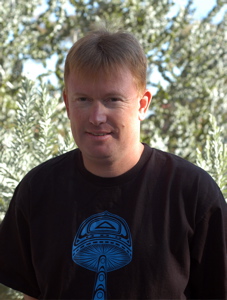
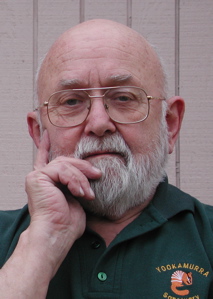
Andrew and Jim
Although authors tend to garner most of the recognition for a book, the adage, a picture is worth a thousand words, is indeed true. That said, creating such an illustration takes an excellent artist who not only understands the concept to be conveyed but also has the ability to render it in a way that is accurate, informative, and yet pleasing to the eye. Gretchen Bracher is such an artist. Hers are the beautiful illustrations that grace the pages of this book. It has been a privilege to work with her.
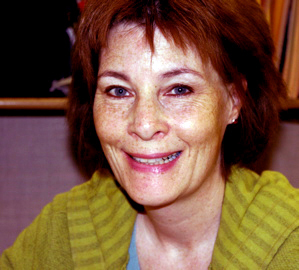
Gretchen
As is often the case, an apparently seminal piece of work rests on the shoulders of an unknown, but dedicated, group of people who remain anonymously in the shadows of an endeavor's precursive stages. This book is no exception.
The person in the shadows is my wife, Zane. Many years ago, when we were first married, she worked for Jim, who taught her to identify the spores from the fungi eaten by the mammals I had been working with. Zane spent countless hours peering through a microscope identifying the spores of mycorrhizal fungi from the many hundreds of samples of stomach contents and fecal pellets I had collected and preserved during my studies of mammals over more than a decade. Her work, although tedious to say the least, resulted in the 1989 publication of the first key to the spores of mycorrhizal fungi eaten by mammals: "Synoptic Spore Key to Genera of Hypogeous Fungi in Northern Temperate Forests, with Special Reference to Animal Mycophagy." As such, it forms the fundamental basis for this book. Without Zane's diligence, this book could not have been written.
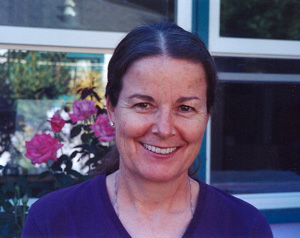
Zane
Among the three of us, Andrew, Jim, and me, we melded 100 years of research experience in a number of countries and continents in writing this book. However, the birth of a book requires the midwife of a publisher, and we are fortunate indeed that Doreen Valentine, the acquisitions editor of Rutgers University Press, saw in our manuscript the germ of a global idea—namely, that in every forest, no matter how diverse, the commonalities of Nature's biophysical principles not only prevail but also are a critical part of the global commons, the birthright of every human being. Doreen shared the importance of this little-known aspect of the global commons with her colleagues in the Rutgers University book team, a turn of events that led to a much-appreciated contract.
Doreen
Fortunately for the reader, Doreen's contribution was far from over. She committed many hours to reading and editing the manuscript, which caused us to make numerous, painstaking revisions—all to the reader's benefit. Hers is the most thorough, general editing I have ever experienced, and among the very best.
A happy Grandma Marilyn
After Doreen's reorganization of our manuscript, it was passed to Marilyn Campbell, who is in charge of production and kept everything running smoothly. Marilyn, in turn, engaged Alice Calaprice, who did a superb job of copyediting, which is an absolute necessity with anything I write because dyslexia adds a definite novelty to my spelling and periodic reversal of words (as you will see if you read my essay,
The "Book Team").

Alice and Albert, her helper
Beyond this, the professionalism of the Rutgers book team has made them a joy to work with. While many—but not all—publishers of today treat authors as little more than vendors, we have been accorded thoughtfulness and respect. In a world where mediocrity, speed, and the "bottom line" have seemingly banished the striving for genuine quality, Rutgers University Press is like a breath of fresh air. Moreover, the end result of the team's efforts will make us look far better as writers than we really are. In addition, Charles Krebs read the final manuscript, and wrote an excellent foreword, which succinctly highlighted our intended message. Who can ask for more than that?
I would be profoundly remiss if I failed to highlight the people and organizations who so generously came forward with the financial assistance to make this book as wonderfully illustrated as it is. Carl Ross (Save America's Forests), Henry Trione, Kieth Olsen, Mike Jani (Mendocino Redwood Company), Paul Harlan (Collins Pine, one of the Collins Companies), Sue Johnston, and Yvon Chounaird (Patagonia, Inc.) all consider the world's forests to be of such vital importance to humanity they were each willing to help fund our book. It is their generosity and commitment to a better world that is reflected in the illustrations and photographs enlivening the forest journey chronicled on its pages. (Return to Top of Page)
The final product
Purchase Information:
This book is available on amazon.